The House of Dried Hydrangeas
~9 min · 1,784 words
The Asagaya neighborhood in Suginami retains the provincial calm of a Tokyo that outlived the speculative bubble of the 1990s.
Two-story dwellings of dark timber huddle along footpaths far too narrow for delivery vans. Beside the sliding gates sit terracotta planters of blue hydrangeas and dwarf pines. The morning storm had subsided, leaving the air washed clean, smelling of wet earth and roasted barley.
Following postal code 166-0031 and a sketch Takumi had drawn on a paper napkin, they halted before a modest home shielded by a low bamboo fence. On the cedar nameplate beside the brass buzzer was carved in kanji: Sato.
Takumi pressed the bell. After two quiet minutes, the slatted cedar door slid back on polished runners.
An elderly woman with curved shoulders and silver hair pinned into a neat chignon peered out through tortoiseshell spectacles. She wore a wool cardigan over a gingham apron.
—Takumi-kun —the old woman murmured in a voice delicate as blown glass—. More than twenty years have passed since you walked up this lane.
—Sato-san —the engineer answered, bending into a profound bow that he held for several seconds—. Forgive my arriving unannounced. This is Salomé Restrepo. She traveled from Colombia. She is an audio engineer.
The woman studied Salomé with quiet dignity. Noticing the professional monitor headphones slung around the young woman's neck, her eyes softened with a familiar ache.
—Please step inside. The barley tea is warm.
They slipped off their boots in the genkan and stepped onto the tatami mats of a parlor devoid of televisions or screens. In the tokonoma alcove stood a small Buddhist altar of black lacquer framing a photograph of Reiko at eighteen, holding an acoustic guitar across her knees with an unguarded smile that lit the room.
Salomé knelt upon the silk cushion, drawing her portable recorder and the San Francisco audio clip from her canvas satchel.
—Sato-san —Salomé spoke gently through Takumi's patient translation—. Reiko left this recording hidden on the master reel before she passed. We believe she intended for you to hear it.
She settled the padded headphones over the mother's ears and touched the play button.
The woman shut her eyes. Hearing the close breath of her daughter and the clear voice reciting the seven digits of their family home, two slow tears traced the deep wrinkles of her cheeks.
—My sweet girl —the mother whispered in Japanese, pressing the headphone cushions against her temples—. She always said that whenever the isolation booth felt like a tomb, she closed her eyes and pictured the hydrangeas by the gate.
The old woman rose with slow determination, went to the recessed cedar cupboard, and retrieved a vintage Danish butter cookie tin tied with a frayed red ribbon. Opening the lid, she laid a sheaf of legal folios stamped by the Tokyo Patent Office in January 2002 upon the low table:
—President Kurata stood in this parlor last autumn holding a check for ten million yen, asking me to sign away Reiko's digital likeness rights —the mother said, looking upon the papers with quiet scorn—. I refused the check. This is the contract my daughter signed upon reaching her majority. Clause Eight expressly forbids any synthesis, mechanical reproduction, or posthumous modification of her vocal likeness.
Salomé took the contract in both hands. The notarized seals were unassailable.
—With this —Salomé met Takumi's gaze— we can halt the Budokan broadcast.
On Friday evening, the elevated glass walkway connecting Shibuya Station to the Shibuya Stream complex was a surging river of suited office workers and students.
Massive wraparound LED displays across the skyscrapers cast shifting ribbons of blue over the wet pavement, flashing the countdown to Saturday's showcase: 24 HOURS REMAINING.
Salomé and Takumi moved along the glass balustrade, carrying the original covenant and the MiniDisc protected in a waterproof sleeve inside her pack. They were heading for the Minato legal offices to lodge the emergency injunction.
—Takumi-san, they are on our heels —Salomé whispered without looking back, her sound engineer's ear tracking the heavy, synchronized strike of leather soles maintaining a steady ten-meter tail.
Takumi caught their reflection in the tinted glass. Three men in matching dark suits and coiled acoustic earpieces were cutting through the throng with rigid shoulders.
—Kurata Media corporate security —the veteran technician muttered, quickening his stride toward the escalators leading down to the public concourse—. If they corner us on the subway platform, they will snatch the bag and call it a street mugging.
At the bottom of the escalator, two more operatives blocked the landing, cutting off access to Meiji-dori avenue.
They were trapped on the intermediate mezzanine, hemmed in by hundreds of commuters oblivious to the squeeze.
The lead operative, a thickset man with a scarred jaw, approached Takumi with his hand hidden within his suit jacket.
—Morita-san —the operative addressed him in flat, clipped Japanese—. Mr. Kurata suggests you hand over the foreigner's pack and accompany us to the sedan waiting in the lower garage. Do not create an undignified scene in public.
Salomé scanned the perimeter with the reflex of a live-sound tech dealing with a blown monitor mix during a festival set.
Ten feet away, mounted into the concrete pylon of the pedestrian bridge, was the steel maintenance panel for Shibuya's municipal emergency evacuation PA system. The hinged hatch stood ajar for fiber-optic cabling repairs.
—Takumi, hand me the mini-plug patch cord —Salomé ordered in an urgent whisper.
—What are you doing?
—Making Medellín heard across Shibuya.
In one fluid move, Salomé slipped past the operative, yanked the steel panel wide, and popped the line return jack from the municipal PA console. In its place, she jammed the headphone output of her portable field interface linked to her phone.
—Grab her! —barked the security chief, lunging forward.
Too late.
Salomé pushed the master fader to unity and tapped play.
From the forty-eight horn loudspeakers strung along the entire Shibuya skybridge, no earthquake siren wailed. Out poured the pure, unvarnished, arresting voice of Reiko Sato singing the opening stanza of her unreleased ballad, cut to virgin tape twenty-three years ago.
The timbre was so raw, so achingly human and unmistakably alive that the river of commuters halted in their tracks.
Thousands of pedestrians crossing the great scramble below turned their faces up toward the elevated bridge. Nobody spoke. The security operatives stood frozen on the deck, hands caught beneath their lapels, paralyzed beneath the collective stare of two thousand onlookers and fifty glowing smartphone lenses filming the scene.
Salomé pulled the reporter's talkback mic to her mouth and spoke into the system:
—This is the real voice of Reiko Sato. And tomorrow night she will be nobody's machine.
Fourteen thousand blue chemical glowsticks swayed in the dark cavern of the Nippon Budokan.
The octagonal arena thrummed with a low electric fever. In the center of the revolving stage, hung beneath an array of high-output laser projectors, drifted a dome of chilled glycol mist illuminated by shafts of stark white light.
In the front-of-house sound pit on the arena concourse, Goro Kurata stood overlooking the main console with a glass of champagne in hand and a thin, predatory smile.
—Trigger the holographic intro —the label president ordered his chief systems architect—. The moment the voice model finishes the opening chorus, open the global streaming stems.
Three floors below in the fiber patch bay, Takumi used wire snips to uncouple the primary line feeding the corporation's digital neural synthesizers.
In its place, he patched the optical digital feed of the TDK MiniDisc player.
Up on the stage wings, Salomé wore the black coveralls of the arena riggers, sporting a laminate pass Takumi had forged from his old union credentials. Using a compact four-channel analog mixer hidden in her pelican flight case, she tapped straight into the master line array returns.
At eight sharp, the house lights plunged into black.
A crushing synthesized sub-bass swell rattled the concrete risers. In the center of the mist dome, the three-dimensional avatar of Reiko Sato coalesced in an ethereal blue shimmer: her white dress rippled in a digital breeze and her eyes blinked with pre-rendered perfection.
Fourteen thousand fans erupted into a deafening roar.
The hologram brought the silver microphone toward its digital lips to unleash the AI-generated dance anthem.
Yet what blasted through the arena's line array towers was no quantized pop track.
Salomé dropped the corporate stems to zero and threw open the MiniDisc feed.
The synthetic beats cut out completely.
What flooded the vast expanse of the Budokan was the solitary, naked sound of an acoustic guitar played fingerstyle, with a slight buzz on the fourth fret and the sharp scrape of a fingernail against pine spruce.
And then came Reiko's voice.
Not the pitch-corrected vocal track of a streaming hit, but her true voice from 2003: husky in the lower register, taking a ragged, trembling breath between lines, carrying that intimate, devastating crack that laid bare the ache of a twenty-two-year-old girl who refused to be owned.
—'If I become an echo' —the voice filled every rafter—, 'kill the machines and let me sleep beside the water.'
The silence that fell upon the fourteen thousand attendees was instantaneous, terrifying, and total.
Nobody cheered. Nobody waved glowsticks. Thousands of young people lowered their arms, transfixed by a human vulnerability they had never once encountered through their algorithmic feeds.
On the arena's mammoth upstage screen, the pirated video feed Salomé had routed overwrote the Kurata Media crest with a high-resolution scan of Reiko's 2002 contract, Clause Eight burning across thirty feet of LED panels.
Goro Kurata dropped his champagne flute; it shattered across the console faders with a dull chime. The label's front-of-house crew stood back with arms folded, refusing to pull the breakers.
Upon the center stage, the hologram of Reiko began to dissolve, breaking into a shower of white pixels that drifted upward into the roof girders like stardust.
The final acoustic guitar chord rang through the quiet and decayed into silence.
For the first time in twenty-three years, Reiko Sato was no longer a corporate commodity. She was a living memory, restored to dignity.
Salomé pulled off her monitor headphones and slid them into her satchel with a long, tranquil breath. She looked out over the darkened arena, where fourteen thousand people rose to their feet in slow, thunderous, reverent applause.
In her pocket, her phone vibrated with a text from her mother in Belén Rosales:
'Mija, it's raining sweet and cool in Medellín. How did the music go?'
Salomé smiled, adjusted her backpack straps, and walked toward the artist exit.
—It went well, ma —she texted back—. The mix came out just right.
End of Episode 11 · of 11
The House of Dried Hydrangeas
Did this episode captivate you?
Invite other readers or create a typographic quote card with your favorite lines.
Read next
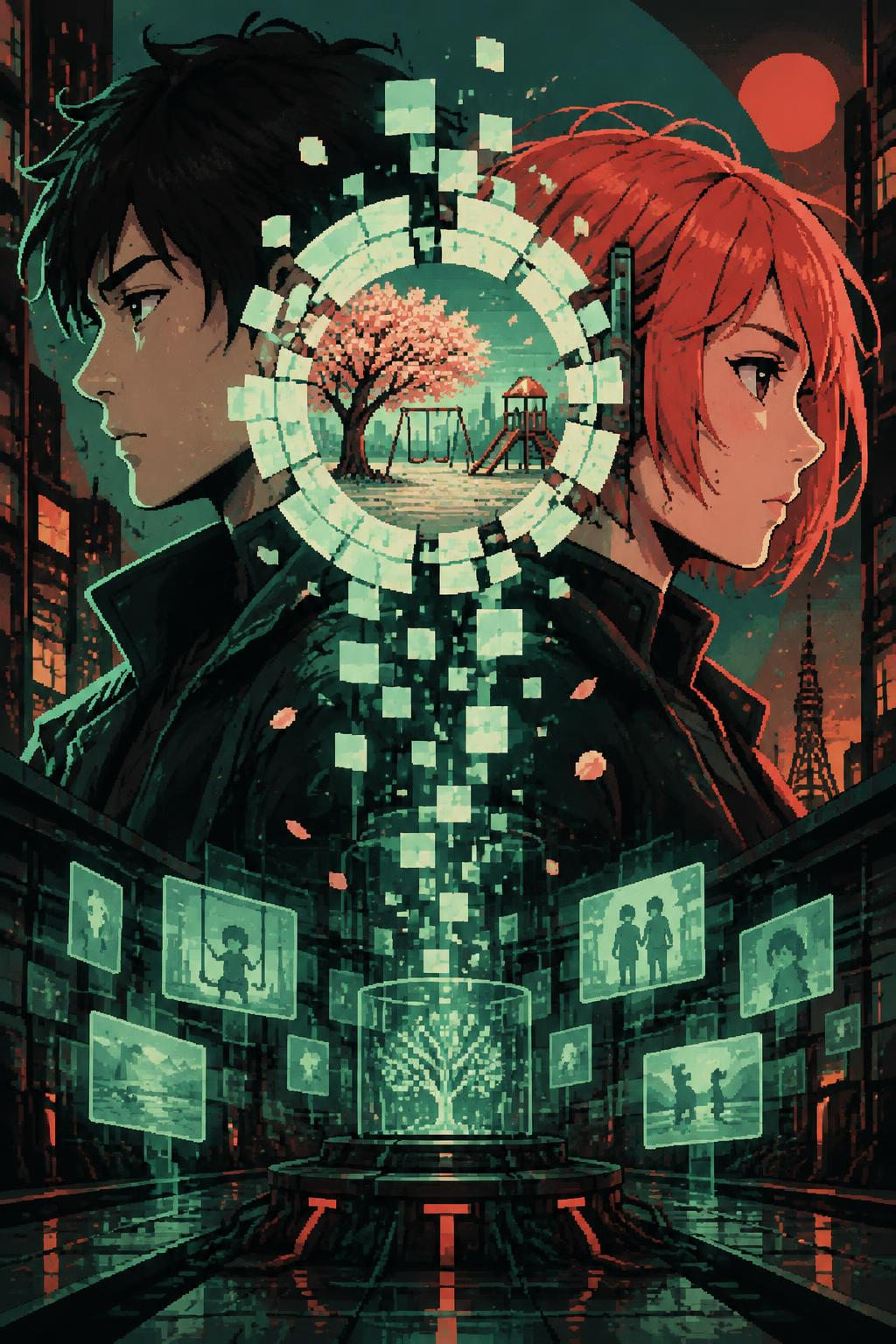
Silicon Echoes
In Neo-Tokyo, people who live alone are being emptied out: the body breathes, the eyes stare east, and no one is left inside. Kenji Ishikawa repairs memories by feeling what their owners felt, and in the shells' backups there is nothing to feel. Only a relief he knows too well, a peach-colored invitation and his own surname. With Aoi, a netrunner who charges in memories, he will have to go down to the flooded servers in the bay before dawn.