The Fissure in the Cistern
~2 min · 467 words
The emergency call from the Heritage Preservation Commission reached Soledad's phone at three in the afternoon.
It was not Donato Ceballos; it was the head conservation architect of the Castillo de San Felipe de Barajas, her voice strained by an edge of hysterical panic she could barely smother across the receiver:
—Soledad, you have to get to the Santa Bárbara battery immediately. The countermine galleries are flooding. And the water isn't coming from the rains.
Fifteen minutes later, Soledad was sprinting up the brick ramps of the fortress beneath a punishing sun that heated the stone curtains to one hundred degrees. At the portal of the subterranean tunnels, three private security guards had strung yellow cordon tape, their halogen lamps resting on the flags.
She descended into Countermine Gallery Four, a headlamp strapped to her hardhat. As she plunged into the roots of San Lázaro hill, the temperature did not climb as was customary within the tropical tunnels; it plummeted into a freezing draft that turned her breath to steam against the brick vaults.
Reaching the vaulted eighteenth-century cistern, she halted with brine swirling past her ankles.
The cistern was not taking water from the ceiling vaults. The liquid was erupting from the floor of refractory firebricks, surging in cold, dense boils that defied gravity, churning up a yellow froth that climbed the inspection stairs.
The architect stood upon a floating timber plank, her engineering plats fluttering in trembling hands.
—Look at the surveyor's benchmark, Soledad —the architect said, tracking the stone with a red laser pointer—. San Lázaro hill stands one hundred and thirty feet above sea level. It is physically impossible for bay water to surge upward by capillary pressure into this vault.
Soledad crouched and dipped her gloved hand into the vortex's core.
Beneath the churn, the colonial Spanish brickwork had sheared in a clean, perfect line, as though split by a cyclopean chisel driven from beneath.
Beneath the fracture lay neither clay nor foundation rubble.
There lay a massive block of dressed slate-gray coral stone, carved to an implacable square edge, polished smooth to the millimeter.
It was the eighteenth step.
The staircase she had discovered beneath the sunken hull of the San Jerónimo at the floor of the bay did not terminate in the marine trench: it sliced through the coastal strata and continued its relentless climb upward through living bedrock directly into the heart of the fortress.
And from the gloom of that chasm, a heavy, subterranean pulse—the deep biological cadence that could no longer be mistaken for any human pump—rattled the brickwork under her knees with such devastating resonance that every work bulb throughout the gallery shattered in unison, plunging the vault into freezing, suffocating blackness.
—It's climbing —Soledad whispered into the dark—. God preserve us, the staircase is climbing.
End of Episode 6 · of 6
The Fissure in the Cistern
Did this episode captivate you?
Invite other readers or create a typographic quote card with your favorite lines.
Read next
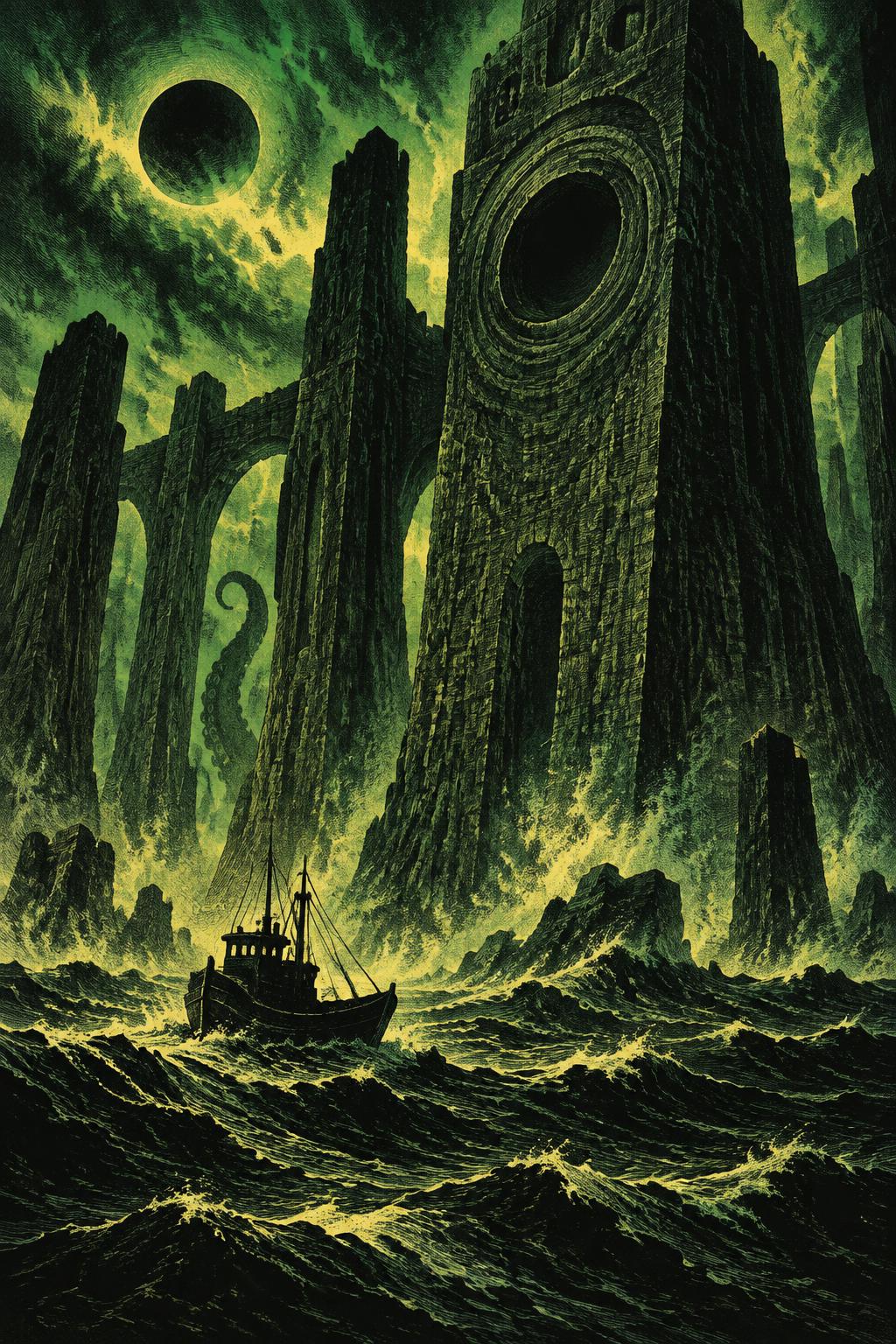
The Call of Cthulhu
Following the sudden death of his grand-uncle, a distinguished professor of languages at Brown University, Francis Wayland Thurston inherits a chilling archive of research. Piecing together notes on grotesque bas-reliefs, police reports from cult raids, and accounts of inexplicable mass delirium, Thurston uncovers the terrifying footprint of a cosmic entity trapped beneath the ocean. This gripping investigative narrative explores human vulnerability and the fragility of sanity when confronted with realities far older and vaster than civilization itself.