The Unchristened Shore
~6 min · 1,281 words
There was no splintering of a broken keel against slate, only a long, thick drag.
The skiff slid over a ridge of black mud and quicksand, losing momentum with the heaviness of a longboat seeking rest on the shore. The wood did not crack; it simply buried itself sideways until the mast, stripped of its stay, buckled toward the bow with a silent lash. Iker's knife drove into the skiff's thwart—barely two fingers away from the parchment—vibrating with a sharp hum that took several seconds to fade.
Then, nothing.
Dawn opened with a spectral stillness. The skiff rested aground on a tongue of dark sand that smelled of decaying seaweed and the unmistakable acidity of iron sulfate, a mineral stench that stung the back of the palate as if someone had scraped a copper cauldron right beneath the nostrils. The low sky kept that leaden, greenish hue of deep water at daybreak, barely cut by copper streaks of humid haze that refused to lift.
Iker loosened his fingers from the wooden handle of the knife. The grip still held the cold sweat of the crossing.
"Did you ruin the parchment?" Noa asked from the stern.
Her voice sounded raspy, as if she had swallowed a handful of ash before speaking.
"No," said Iker.
"Bad habit, that of doubting."
"If I had slashed it, we'd have been left without water beneath us, Noa. Or without air."
"Or without stones," she retorted, groping blindly beneath the broken tiller until she found her tin canteen. "Though it makes no difference either way. We are stranded in the middle of nowhere."
She unscrewed the cork stopper, sniffed the rim out of sheer inertia, and took a short sip. She grimaced.
"It tastes like iron."
"Everything has tasted like iron since last night."
Iker stood up clumsily after four hours hunched over the lead lining trying to bail the un-bail-able. He looked down. Argus's vellum lay soaked across the half-deck, shriveled at the edges like a crust tossed onto embers; crusts of saltpeter accumulated in the folds with the sandy feel of dead lime, but the crimson stroke—that cape drawn with the fury of a desperate pulse—matched millimeter for millimeter the black curve of the sandbar where they were planted.
A petty inventory of losses floated in the stagnant bilge water: two loose copper nails, half a rope frayed by the rubbing of the stem, the lid of a zinc mess tin that would never close again, and a crust of stale bread slowly dissolving into a yellowish stain.
Noa jumped overboard.
The mud reached mid-calf with a wet squelch that sounded like a deflating bladder. She cursed under her breath, grabbed the gunwale, and took three steps toward solid ground, dragging her legs with the mechanical sway of someone who has spent too many days on floating planks.
"The bottom is firm," she said, without looking back. "Volcanic sand and crushed shell. We aren't going to sink."
Iker did not answer right away. He stared at his own fingers: the sepia ink stains beneath his nails were still there, refusing to vanish no matter how hard he scrubbed them against the coarse canvas of his breeches. It was a stubborn, persistent mark, like the memory of the shopkeeper's face in Caelum that very morning which he tried in vain to recall; the woman had a wart on her chin and sold turnips in winter, but Iker no longer remembered the tone of her laughter nor the exact way her eyelids wrinkled when she collected the coins.
The earth does not wait to be discovered; it waits for someone whose hands are stained enough to hold its first outline.
The phrase was not in Argus's oxhide notebook, or at least Iker did not remember reading it there—the old chroniclers of the navy used to attribute such maxims to dead cartographers to justify the lack of provisions in their logs—, but it came to his memory with the precision of a slap.
"Help me lower the tool chest," Iker asked, swinging one leg over the gunwale.
The leather of his boots creaked like old bones upon touching the cold silt. The undertorrent receded slowly, exposing ridges of black schist polished by centuries of tides that no human eye had recorded.
"Leave the chest," said Noa, resting her hands on her hips as she stared at the coastline. "If the tide rises before noon, the skiff will float off by itself. And if it doesn't rise, we have nowhere to take the irons."
"Argus had a portable forge in the workshop. He said soft iron settles courses."
"Argus said a lot of nonsense before running off in the dark."
Noa bent down to scratch an ankle over her wet stocking. There was a deliberate sluggishness in her movements, that feigned calm of sailors who prefer to fix rigging rather than admit they do not know in which quadrant of the world they have fallen.
"Do you have any tobacco left?" she asked.
"It all got soaked in the reef beating."
"Pity."
"It was bad anyway. Stung the throat."
"Didn't matter. It made smoke."
They walked some fifty paces inland, following the irregular line left by the foam as it died upon the black gravel. The air did not move; it was a warm, dense mass that seemed to have been locked in a boarded-up attic for decades.
To the left, the remnants of the morning haze dissolved into ash-gray shreds, revealing a wall of rock that appeared in no known pilot book. It was no normal cliff: the stone showed parallel grooves, extremely fine channels carved by a continuous, ancient dripping, as if a colossal hand had combed the mountain with a carpenter's gouge before the clay dried.
Noa stopped dead in front of the splintered figurehead of a longboat that the undertorrent had dragged to the first slate dunes. The wood was eaten away by shipworms, gnawed until it looked like a dry wasp's nest.
She sat down.
She rested her back against the rotten wood of the figurehead, stretched her right leg with a muffled huff, and unlaced her leather boot with slow, patient movements. She tipped the footwear to one side; a stream of saline water and coarse sand fell onto the gravel with a gray splash.
Iker stood beside her, hands thrust deep into the pockets of his soaked jacket, staring at the landscape taking shape some three hundred meters away.
"It's not on the maps," he murmured.
"Nothing we walk on is on the maps, Iker," Noa replied without looking at him, feeling her toes to make sure she still sensed them. "That's why you brought the ink."
Noa thrust her hand inside the soaked lining of her empty boot, searching for some pebble that might have grazed her instep, but her fingers brushed against something else. She pulled it out carefully. It was neither a rock flake nor a piece of stiffened seaweed.
It was a white shaft.
A seabird's feather, long and rigid, with the quill cut on the bias with a clean slash that only a razor penknife could have traced. The tip kept a black crust, dense, almost vitreous: abyssal sepia coagulated by brine.
Noa handed it to him in silence.
Iker took the feather between his index finger and thumb. The quill was cold, but upon squeezing it slightly it gave off a whiff of that same acrid sulfate odor that had permeated Argus's empty workshop before they set sail.
Ahead, tearing through the low mist beginning to retreat westward, stretched a virgin mountain range that still had neither name nor shadow.
End of Episode 4 · of 4
The Unchristened Shore
Did this episode captivate you?
Invite other readers or create a typographic quote card with your favorite lines.
Read next
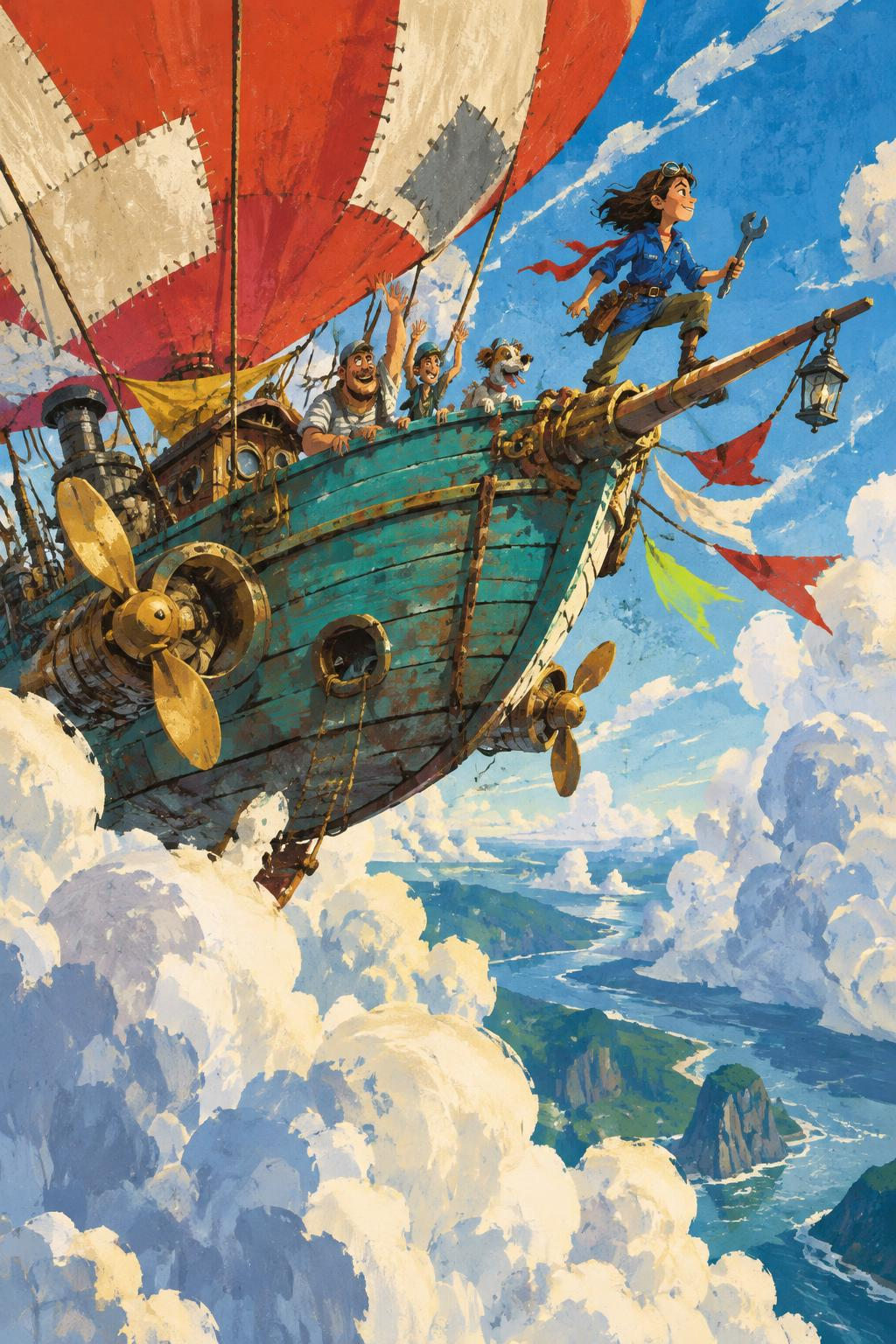
The Last Cloud Ship
The Harbor Command declared Mara Ibarra's father drowned on the southern reefs and sent her mother an empty chest and a denied pension. Mara doesn't believe it: wrench in hand, she sneaks into the bilge of the last flying galleon, where the old engineer Onofre Cuesta finds her before the ship casts off. Down there she finds her father's signature, dated three weeks after his official death, and soon understands why the corvette of Arteche, the Harbor Command's bloodhound, is chasing the galleon through the upper strata: he wants what her father hid on board.