The Broken Oath
~8 min · 1,528 words
Lianor Aurion's left hand trembled, and she had been hiding it for three months.
She hid it in the sleeve of her tunic during lessons, pressed it against her thigh at Council dinners, tucked it under the pillow at night, when she didn't sleep. That morning she had bound it with a strip of white linen, as if she had cut herself on glass, and nobody had asked. In the Heart of Aurion, on the day of the oath, nobody looked at the heir's hands. They looked at the dome.
The great dome rose over the highest terrace of the city, a shell of amber glass the size of a square. Below it, in rows that stepped down to the river, the lightjars waited: three thousand thick glass jars sealed with wax, in which the weavers had stored a whole year of summer sun. Today that light had to rise into the dome, thread by thread, so the city wouldn't spend the winter in the dark. Her mother had done it for twelve years. Albano had done it for the nine after that. Today it was her turn.
The terraces were full. Whole families with blankets and baskets, children on their fathers' shoulders holding little hand mirrors to catch the first glints, old people who had seen forty oaths and still took off their hats. It smelled of aniseed bread and warm wax.
"Breathe," Albano told her quietly. The High Keeper stood at her right, dressed in white, hands clasped behind his back. "Light isn't forced. It's invited."
He had told her that a thousand times since she was ten. Lianor nodded, unwound the bandage from her left hand and tucked it into her belt. The tremor was still there, fine as a lute string.
She raised both hands.
At first nothing happened, and somewhere on the terraces someone coughed. Then the wax of the first jar softened, and a thread of light rose out of the glass the way steam rises from a pot: slowly, curling. It was amber. Her mother's color. Lianor took it between two fingers, felt its warmth like sun-warmed stone, and sent it upward. The thread climbed the air, found the dome and clung to the glass like a ray of honey. The crowd let out its breath all at once.
Then there were ten threads, a hundred, a thousand. Lianor stopped thinking about her hand. She wove with her arms wide, with her neck, with her breathing, and the light rose from the jars like rain falling upward, and the dome began to glow from inside like a lamp waking up. Below, the children turned their mirrors and filled the façades with golden spots. She thought her mother would have smiled. She thought she was doing it right.
Then the amber turned gray.
It didn't go out. It went still and colorless, like the light of an overcast day painted on a wall. The threads hung in the air, gray, and the whole dome turned the color of ash. With the color went the sound: the murmur of the crowd, the splash of the fountain, the swift crossing the square. Lianor opened her mouth and couldn't hear her own gasp.
For three heartbeats, nobody in the Heart of Aurion knew why they were there.
Lianor felt it as a hollow behind her eyes. She looked at her raised hands and couldn't remember why she had lifted them. Beside her, Albano was staring at nothing. On the terrace below, a girl with a hand mirror turned to the woman holding her hand and asked, as calm as anything:
"Who are you?"
And then it all came back at once: the amber, the noise, the swift. The woman pulled the girl against her skirts. People began to scream.
The threads Lianor was holding snapped and fell on the jars like warm ash. The dome was left half lit, one side golden and the other dark. Lianor lowered her left hand. It was shaking so hard she had to hold it with her right.
"It was me," she said.
"No." Albano gripped her wrist hard without looking at her. His eyes were on the west. "It wasn't you. Look."
Across the river Albar, above the cliffs where the Umbral had carved their city, the veil rose every nightfall: a column of thick shadow that settled over the Hollows and brought sleep. It was midday, and still Lianor saw it. A dark column rising from the cliffs at the wrong hour, coming apart at that very moment like smoke in the wind, gray and spent.
"They've lost it too," Albano said.
Then he lifted his eyes north, toward the Veiled Peaks, and Lianor followed his gaze. Above the snowy summits there was a thin line in the sky, straight as a seam. It wasn't a cloud. It was gray, and the blue seemed to fold toward it.
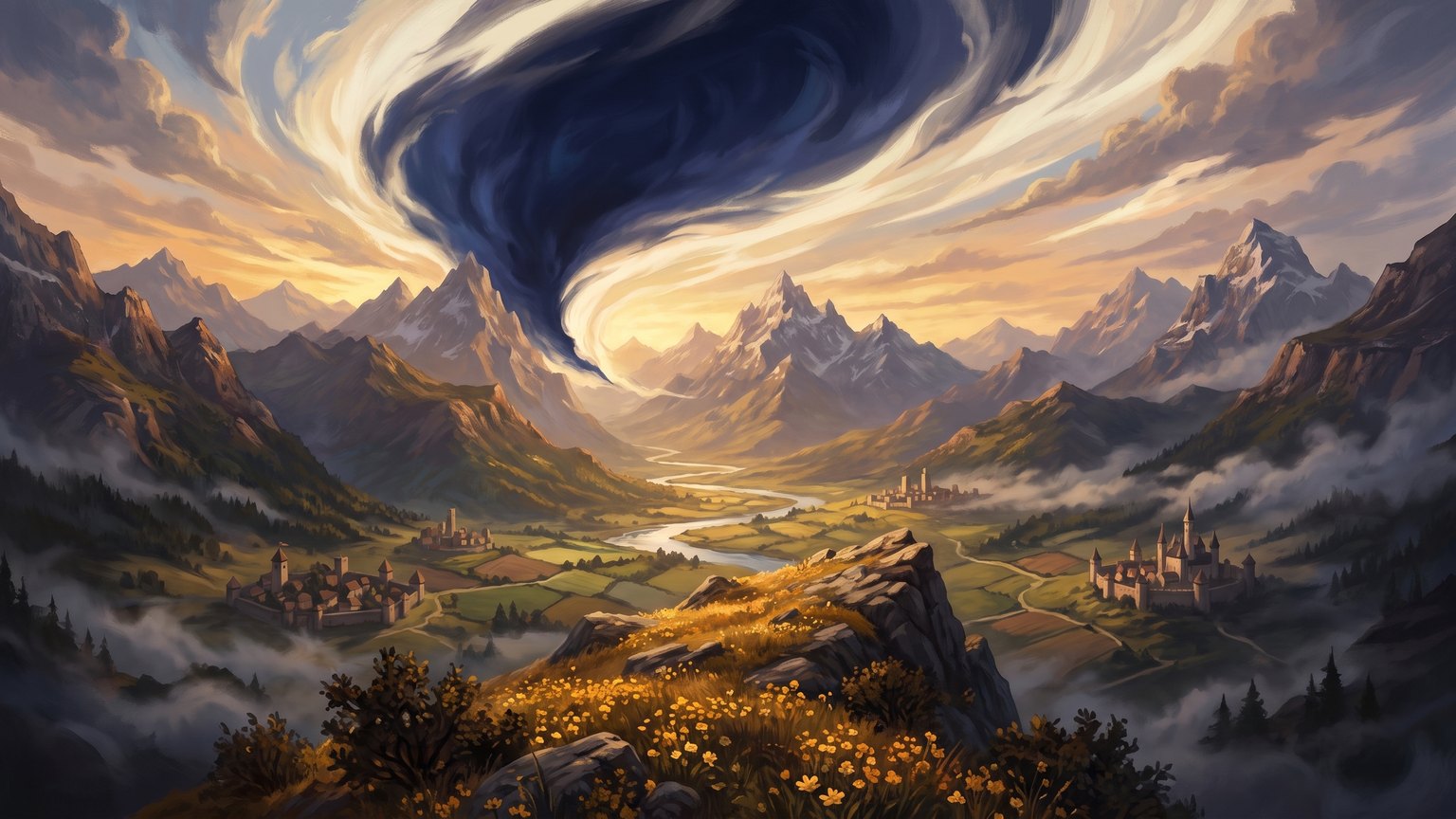
At dusk, in the Council Chamber, the reports came one after another. In Ruesca, the shepherds' village at the foot of the Peaks, there were people who had forgotten words: a man couldn't remember what a spoon was called and wept with it in his hand. In the northern orchards, the apple trees had lost the color of their leaves in a strip a stone's throw wide. And under the Weavers' Bridge the river ran gray.
"It has a name," Albano said, once the elders had tired of talking over one another. "The old books call it the Rift. It opened once, a thousand years ago, when the house of weavers split in two. It eats whatever it finds: color, sound, memory. If it isn't closed, within a year this valley won't know its own name."
Nobody asked how it could be closed. At that moment there was a knock at the door.
It was an Umbral messenger, a skinny boy with a white veil over his face, the oldest sign of peace in the valley. His legs were shaking. The guards brought him to the center of the Chamber with their spears lowered, and he left a letter sealed with black wax on the table and backed away without turning around.
Albano broke the seal and read aloud.
"'Tomorrow at nightfall, at the Twilight Enclave. Bring your heir. We will bring ours. Isolda Umbral, Matriarch of the Hollows.'"
The Chamber erupted in a scraping of chairs. Someone said "trap," someone said "never," and an old woman struck the table with her cane and said the word everyone was thinking: the bridge.
Lianor said nothing. Nine years ago, on the Weavers' Bridge, on a night of truce, the Umbral had attacked the Aurion procession. Her mother had been walking in front with a lightjar in her hands. They never let her see the body. They only gave her back the jar, broken, and the amber ribbon her mother wore in her hair.
"I'll go," she said.
The chairs fell silent. Albano looked at her for a long time, and Lianor thought she saw something like pain in his face.
"And if it's a trap?" she asked.
"Then I'll walk in first," he said.
She didn't sleep that night either.
She went down to the river alone by the orchard stairs, a small lightjar in her hand, and walked along the bank to the Weavers' Bridge. The bridge was still there, an arch of white stone that nobody crossed anymore; in the middle, the Aurion guard had driven in an iron gate, and on the far side the Umbral had driven in another. Between the two gates, nettles grew.
Under the bridge, the Albar ran gray.
It wasn't mud. The water was clear, you could see the pebbles on the bottom, but it had no color and no sound. It flowed in silence, like a drawing of a river. The gray stain already covered half the channel and was creeping toward the Aurion bank, slowly, eating the green of the reeds.
Lianor knelt on the stone and held the jar out over the water.
She saw the sky, the moon, the arch of the bridge, the amber glow of her jar. She didn't see herself. Where her face should have been, there was still water.
She jerked back. The jar rolled across the stone and lay glowing beside her knees. Lianor touched her face with the hand that trembled, to make sure it was still there, and then she heard a voice across the river. A man's voice, low, with the clipped accent of the Hollows.
"I can't see myself either."
On the opposite bank, forty paces away, a young man dressed in black was crouching by the water just as she was. He carried no light. The moon outlined his shoulders and his dark hair, and an open hand over the surface of the river, which didn't give him back his reflection either. They looked at each other across the gray water. Neither of them moved.
Then he raised his hand and pointed down, toward the middle of the channel, where the stain had just reached both banks of the river at once.
End of Episode 1 · of 12
The Broken Oath
Did this episode captivate you?
Invite other readers or create a typographic quote card with your favorite lines.