The Shore of Free Waters
~4 min · 866 words
They reached the docks of Valdelobos at dawn. The news had come down the bank faster than they had, on horseback, and half the town was waiting at the landing: bargemen, millers, women with baskets, children perched on barrels. And, in front of them all, arms folded and the silver chain of office on his chest, the senior syndic of the vintners' guild.
"You've put the whole guild at war with the barons, Nuño Arceo," he said before the wedge had finished docking. "Without leave. Against Sunday's vote."
Nuño stepped ashore with his forehead bandaged and the axe still in his belt. He didn't answer at once. Behind him, Sira was hauling on the line to make fast.
"Where is Remigio?" Nuño asked at last.
The senior syndic blinked. It was a small blink, but a hundred people on the dock were watching him and all of them saw it.
"I don't know what you're talking about."
"Last night Remigio crossed to the inn under the poplars to tell the barons what time we'd pass. Remigio can't read or write and hasn't had an idea of his own in fifteen years." Nuño spoke slowly, so that even those at the back could hear. "Someone told him to go. Someone who voted on Sunday that we should keep paying."
No one said anything. Then, from the back of the dock, a woman shouted the name of her husband, who had lost a boat at the ford the year before, and then another, and after that there was no way for the senior syndic to say anything that could be heard.
The senior syndic took off his silver chain of office that same afternoon, without anyone asking him to out loud. Remigio wasn't found. At the inn under the poplars they said he had crossed the border southward before dawn, with a new purse on his belt and without saying goodbye to anyone.
The Oakhaven ore was sold that same morning, at a price from before the long winter and without a single maravedí for the barons. With what they were paid, Sira bought wheat: forty carts of wheat from the river flats, to go up toward Oakhaven along the towpath, with mules hauling the empty barges upriver, as hadn't been done for three centuries.
They signed the agreement on the deck of the barge, on a barrel stood on end. The two councils: Oakhaven's by the hand of Sira, who carried a letter from the prince, and Valdelobos's by the hands of the three who had voted against on Sunday. Free passage on the Arlanza, without chains or tolls, and mutual aid if the barons ever laid iron across the river again. It wasn't a peace. It was an agreement among boatmen, which tends to last longer.
Before signing, one of the three vintners, an old man with hands stained purple from treading grapes, came over to Sira and shook both her bandaged hands without a word. Then he turned to the Oakhaven bargemen waiting at the other rail and made them a clumsy bow, the bow of a man who had never bowed in his life.
At midday someone lit a bonfire on the bank and someone brought out a lamb, and by afternoon there were bagpipes. Sira didn't dance. She sat on a log with her bare feet in the calm water, her hands bandaged, and watched Nuño come over with two cups of wine and a loaf.
"Old vines," he said, holding out a cup. "I promised you."
"You promised me the cherry trees."
"Three weeks to go."
She drank. It was a dark wine, rough at first and sweet afterward, like some people.
"Tomorrow I go up with the wheat," said Sira. "Oakhaven needs it before sowing. It'll take me ten days to get there with the mules and five to come back on the current."
"Fifteen days."
"Fifteen days." She touched the amber through her shirt. "And then the next load of ore has to come down. And then the wool. And then we'll have to see whether the barons learn."
Nuño sat looking at the river.
"I don't know how to steer," he said. "But I know how to row against the current all night. I've got the hands to prove it."
"Are you asking me for a place at the oars?"
"I'm asking you to come back to the cherry trees. With the wheat or without it. And if you'll let me, I'll go with you to take it."
Sira didn't answer in words. She rested her head on his shoulder and they stayed like that until the sun set over the Arlanza, which was already flowing without chains, with the same mud as ever and all the freedom in the world.
The next morning the four barges began to go up the river loaded with wheat, hauled by twenty mules along the towpath. In the stern of the first stood Sira, the tiller in her bandaged hands. On the bow rowing bench, not quite sure what to do with his oar but willing to learn, sat the syndic of the vintners of Valdelobos.
End of Episode 4 · of 4
The Shore of Free Waters
Did this episode captivate you?
Invite other readers or create a typographic quote card with your favorite lines.
Read next
Ashes of the Safe-Conduct
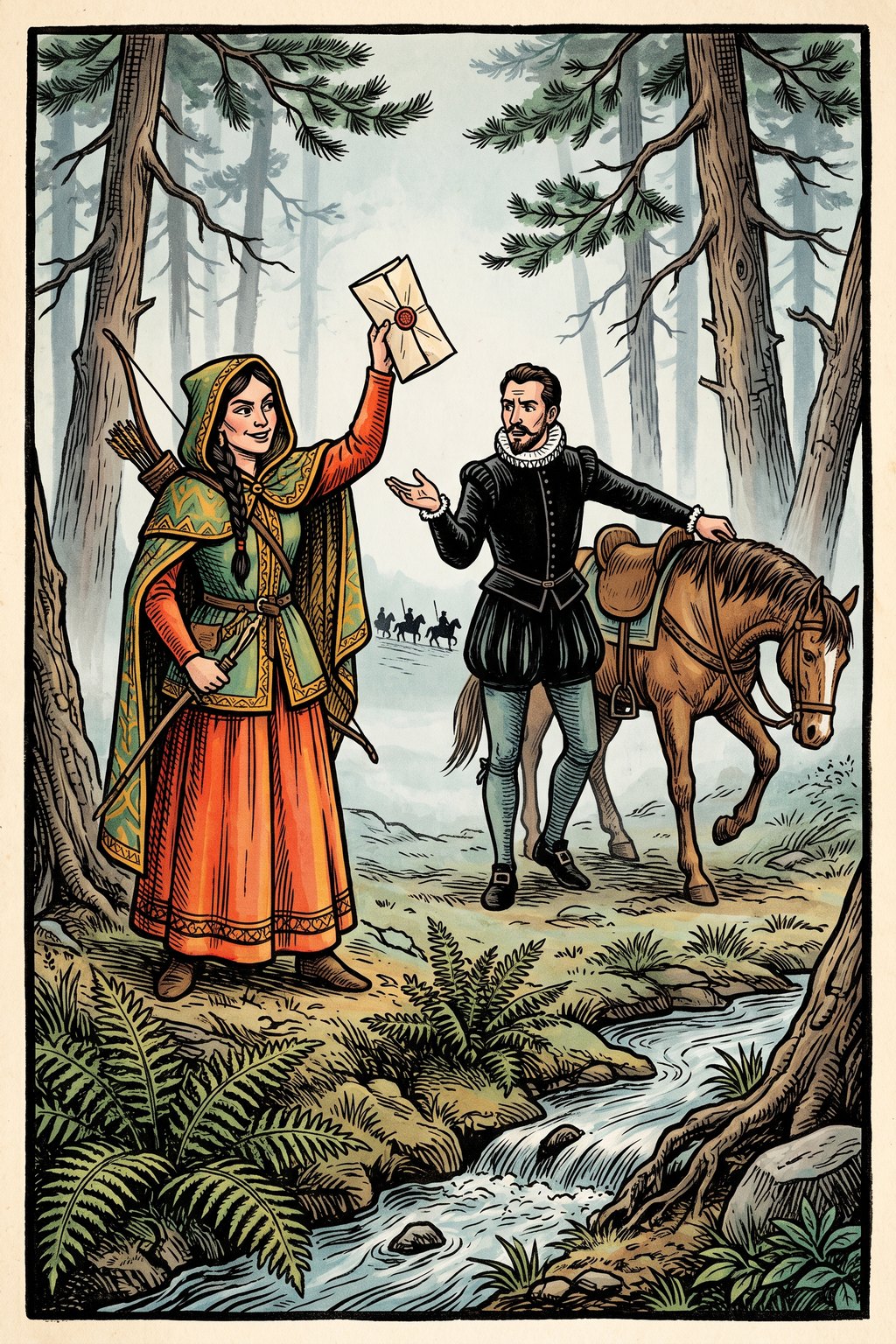
One night in the archive, Don Íñigo de Vivar, an auditor at the Chancery in Burgos and cousin to Doña Beatriz, finds the secret order to invade Oakhaven before the truce can be ratified, signed by his uncle, the grand chancellor. He steals it and flees north with his auditor's safe-conduct, the paper that opens every bridge and that, from dawn onward, also gives him away. In the forest of the Mist, his horse lame and the Black Guard behind him, he is found by Irati, a huntress whose family died under southern lances. She agrees to guide him to the Gorge of Souls on one condition: she keeps the safe-conduct as a pledge.