The Horizon Line
~4 min · 822 words
Rodrigo cut the ash staff into stakes with Leonor's knife, each a span long, and drove them in along the new line, one every twenty paces, over the spur that skirted the maze. Leonor walked behind him pulling them out. It was no game: in the fresh snow their tracks showed only from stake to stake, and as soon as she pulled one, the morning wind began to fill in the hole.
Below, the escort was climbing fast along the easy way: the old tracks from the day before, which ran straight toward the third Sister. Straight into the maze.
By mid-morning, from the top of the spur, they saw them reach the edge. Ten men in morions and greatcoats, a captain on foot with his sword drawn, a friar from the monastery serving as their guide. They stopped dead where the tracks ended at the lip of the first crevasse, wide as a street in Burgos. The captain stepped forward two paces, looked down and stepped back three. He shouted something the wind brought up in pieces. Deserter. Whore. Gallows.
Rodrigo couldn't answer him. Leonor could, but she didn't give him the satisfaction. She stood beside Rodrigo watching the ten men search for a way across to the left and to the right, slower and slower, until the friar pointed at the sky, where the snow was piling up again, and the captain sheathed his sword.
They watched them go down. Neither of them said anything for a long while.
In the tin cylinder, beside the portolan, were the boundary charters Queen Elenora had signed with the first councils of the valley. Leonor had pried them out from under her uncle's flagstone with a kitchen knife. With them in hand, any farmer in Valdelobos could stand before the prince of Oakhaven and prove that his pastures had never been wasteland.
"My uncle will say I stole them," she said, watching the black dots grow small on the snow.
Rodrigo wrote on the slate: He stole them first.
They reached the saddle at dawn on the fourth day, their feet bleeding inside their boots and their cloaks stiff with frost. On the other side, the world opened northward like a green cloth waking from a three-hundred-winter sleep: the valley of Oakhaven, the great river running free toward Valdelobos and, in the distance, the stained-glass windows of the ducal stronghold lit by the sun like a swarm of fireflies.
Rodrigo dropped the saddlebag. He knelt on a sunlit slab of slate, unrolled the blank parchment he had carried for four days and opened the compasses.
Leonor knelt beside him with the horn inkwell in her hands. She had taken off her coif in the orchard on the night they fled, and the wind stirred her dark hair.
Rodrigo drew the range of the Silent Lands as no one had ever drawn it. The saddle, the nameless spur that had saved their lives, the maze of crevasses with a warning in red letters, the springs among the crags, the shelters from the blizzard, the track by which wheat carts could climb without paying in Burgos. Beside the queen's old line, in paler ink, he recorded the glacier that had come down. He erased nothing. A map that hides its mistakes, he thought, is just another lie with contour lines.
Leonor pointed out with her finger the cisterns and ruins mentioned in the monastery chronicles, and he placed them with two measurements and a stroke. So, between the two of them, they put into a single parchment what the monks knew and what the mountain knew.
At the foot of the map was the space for the seal. Rodrigo held out the pen.
Leonor dipped the nib in the sepia ink and wrote in her copyist's hand: Drawn upon the free peaks by Rodrigo de Molina and Leonor de Ayala, who measured it with their feet.
Below, on the sunken road that climbed from Oakhaven, a patrol of riders in brown cloaks under a banner of wheat ears had seen the smoke of their tinder and was starting up toward the saddle.
Rodrigo put the map in the tin cylinder. Then, before they arrived, he took Leonor's hand, opened her palm and wrote on it with his finger, slowly, the word he had gone two years without being able to say to anyone.
She read it. She closed her hand over it the way one keeps a coin.
It took them an hour to arrive. The leader of the patrol, a young man with a frozen beard, reined in his horse ten paces away and looked at the stiff cloaks, the feet wrapped in rags, the black ribbon at Rodrigo's neck.
"Who goes there?" he asked.
"Two cartographers," Leonor answered for them both. "We're bringing a road."
She didn't open her hand the whole way down to the valley.
End of Episode 4 · of 4
The Horizon Line
Did this episode captivate you?
Invite other readers or create a typographic quote card with your favorite lines.
Read next
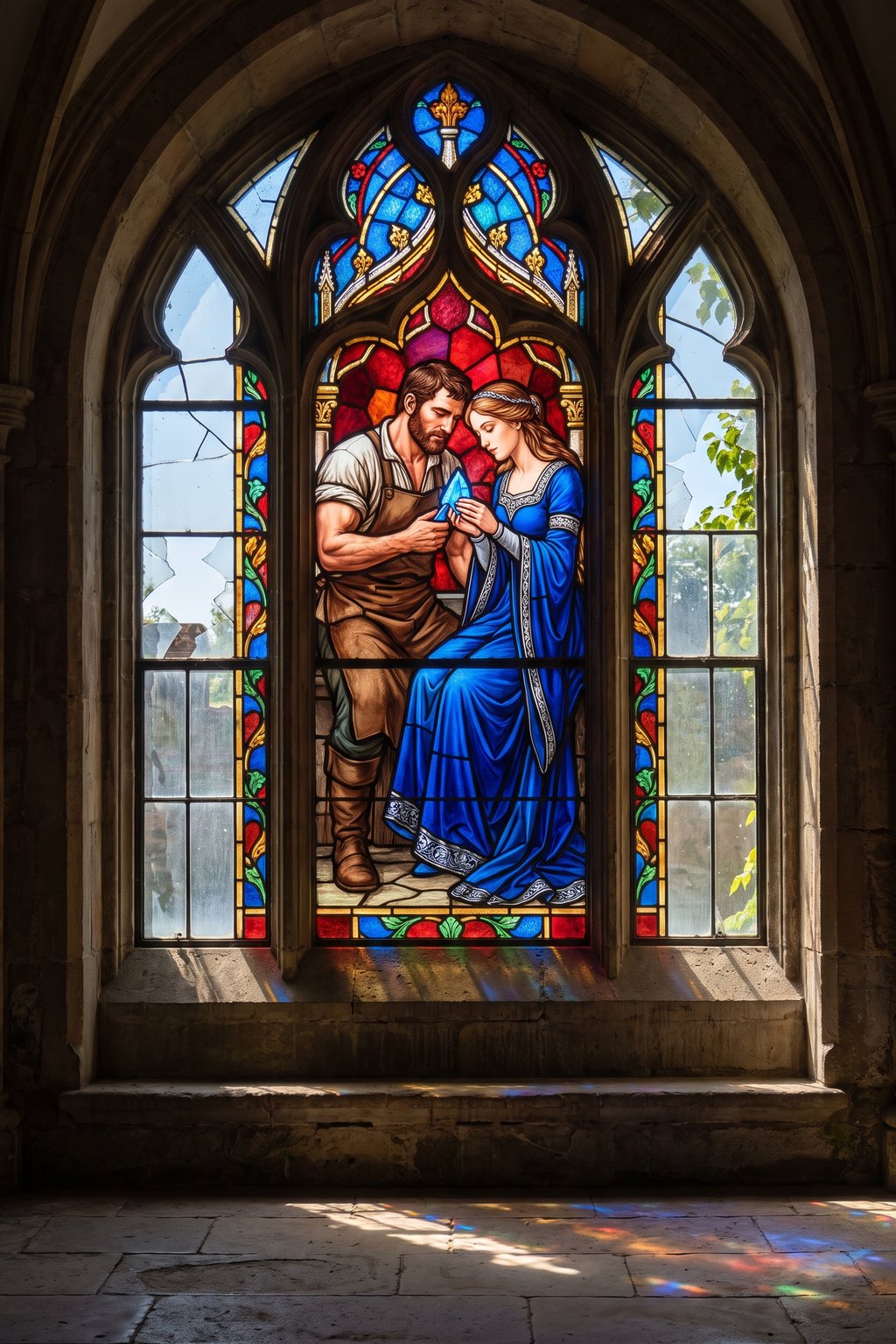
The Smith of the Parapets
On the night of Archduke Morvath's coup, southern arrows shattered Oakhaven's three hundred stained-glass windows. The master glazier died in the gallery, and Prince Fadrique puts the rule into the hand of Bruno, the master armorer, who knows iron and nothing of glass: he has forty days, until the April sleet. In the last stall of the stables he finds Doña Brianda de Soria, a lady of the enemy's retinue abandoned by her countess, armed with a shard of cobalt and raised among the glass workshops of Toledo. She knows what he lacks. But Oakhaven has too many dead for anyone to want to work with a southerner, beginning with Ciro, Bruno's apprentice.