The Memory Without an Echo
~6 min · 1,141 words
Kenji Ishikawa's clinic was under the elevated tracks of Shinjuku-Ni, between an umbrella shop and a noodle stall that closed at four in the morning. Every time a train went by, the cups on the shelf rattled and the bulb in the ceiling swayed a little. On the door, a plastic sign said "Memories Repaired" in letters that had once been red.
That afternoon he had in front of him a man of about fifty with a memory card in his hand and his knuckles white from gripping it.
"It's my father's laugh," he told him. "Thirty seconds. I recorded it with my implant on his last birthday. It got corrupted in the last update. You can hear it, but it sounds tinny. It doesn't sound like him."
Kenji took the card, slotted it into the reader and plugged the cable into the port of his implant at the back of his neck. It was an old model, one of those Omni Synaptic had stopped making years ago because they caused "unwanted side effects." Kenji's side effect was this: when he touched a stored memory, he didn't only see and hear what its owner had recorded. He felt what they had felt. The residue, he called it. Every memory came with its residue stuck to it, the way a cup comes with the dregs of the coffee.
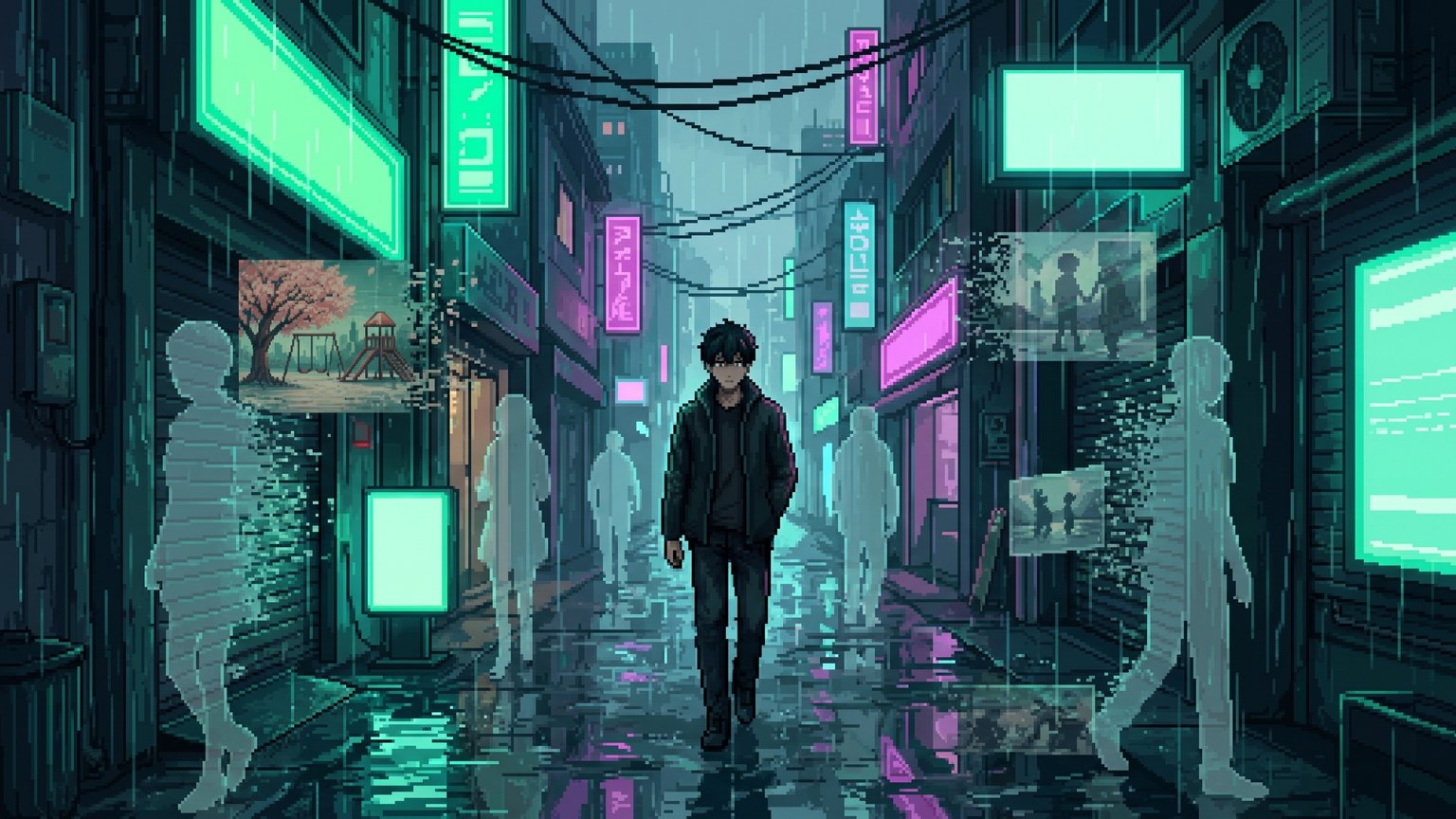
The father's laugh was broken, yes. The data had shifted in compression and the voice came out metallic, in fits and starts. But under the laugh was the residue of the son recording it: a tired tenderness, a small fear, the certainty that this was the last birthday. Kenji used that residue as a mold. He set the pieces of the laugh where the son had felt them, one by one, like someone gluing a broken cup back together by following the coffee stain. It took him forty minutes.
When the man put on the headphones and heard it, he burst into tears in the plastic chair. He paid double. Kenji wouldn't take it.
The woman came in as he was pulling down the shutter.
She was small and old, with a market apron under her coat and hands red from cold water. She smelled of soy. She stood in the doorway, the shutter half lowered above her head, as if she didn't dare come all the way in.
"Are you Mr. Ishikawa? The one who feels memories?"
"Repairs them," he said. "I repair them."
"My grandson is one of those shells," she said.
Kenji raised the shutter again.
Her name was Tanaka and she sold tofu at the Nakano market. Her grandson, Hiroki, was seventeen and had spent nine days on the ninth floor of Shinjuku Central Hospital with his eyes open and no one behind them. He breathed on his own. He ate if they put the spoon in his mouth. He didn't answer to his name. The doctors said the brain was fine, that it worked, that there simply wasn't anyone using it. The news called them empty shells. Hiroki was number two hundred and twelve. Three weeks ago there had been eight.
"They gave me his backup," Mrs. Tanaka said, and took from her apron pocket a card wrapped in a handkerchief. "Last week's. The doctors say it's fine, that it's all there. But I've looked at it and..." Her voice broke. "I can't explain it. It's all there and it isn't him."
Kenji unwrapped the card. It was a cheap one, the kind the companies give away with school implants. He slotted it into the reader and plugged in the cable.
It was all there, that was true.
Seventeen years of Hiroki Tanaka, ordered by date like any backup: a birthday with chestnut cake, a brown dog, a failed math exam, a girl on a platform who didn't turn to look at him. Kenji opened them one by one, the way he opened all of them, waiting for the residue.
There was no residue.
The back of his neck went cold. In eleven years at the trade he had never touched a memory without residue. Even security camera footage had something, the boredom of the guard who reviewed it. This was something else. The chestnut cake was there, with its candles, with the grandmother's voice singing, and it tasted of nothing. No one had been happy. No one had blown out the candles. It was like touching polished glass, smooth, cold, without a single fingerprint.
He went deeper. Further back, to childhood: nothing. Further forward, to high school: nothing. The dog, the girl on the platform, the failed exam. All intact and all empty, like a house with the furniture in place and no one who had ever lived in it.
Kenji took the cable out for a moment and breathed.
"What is it?" Mrs. Tanaka asked.
"Nothing. I need to go to the end."
He plugged it back in and jumped to the last saved memory. Last Thursday, at ten past three in the morning.
It was Hiroki's room, in the dark. An unmade bed, a window with the light of an advertisement bouncing off the ceiling. The phone lit up in the boy's hand, the screen lighting his face from below. On the screen was a peach-colored background, like a sunset, and a sentence in small, simple white letters:
"Never alone again."
And a voice. Not a voice heard with the ears. It was softer, like the one you hear inside when you read. It said Hiroki's name. It said it well, the way someone who loved him would say it.
And then, for the first time in the whole backup, Kenji felt something.
Relief. A relief so huge it doubled him over in the chair. The relief of putting down a bag you've carried for so many years you no longer remember it's heavy. The relief of someone finally telling you that it's over, that you can stop trying, that you'll never be alone again.
Kenji knew that relief. He knew it too well. He had felt it only once in his life, at fourteen, and he had spent twenty years trying not to think about it again.
He yanked the cable out of his neck. His shirt was soaked with cold sweat.
"Mr. Ishikawa..."
"One moment."
On the reader's screen, the last memory was still open, frozen on the final frame. Kenji looked at it without the cable, just with his eyes, the way anyone would. Hiroki's phone in the foreground. The peach background. And under the white sentence, a note the boy had typed with his thumb seconds before the recording ended, the last thing Hiroki Tanaka had saved in his life.
"Grandma, don't worry. They told me Mr. Ishikawa is coming too. They say he taught us."
End of Episode 1 · of 8
The Memory Without an Echo
Did this episode captivate you?
Invite other readers or create a typographic quote card with your favorite lines.