The Embers and the Frost
~8 min · 1,515 words
A tin spoon bent at a right angle, abandoned on a stone ledge where the mortar crumbles into gray scales. Nobody remembers who twisted it or for what purpose, but it remains there, receiving the same film of cold grease that coats the hinges.
Dawn breaks in a whitish gray over the exterior basalt and a cup of hot chicory steams between Darío's chapped hands. Outside there are no birds, only that shade of sour milk the fog takes on when it clings to the cuts in the rock and leaves no telling where the wall ends and the precipice begins. Heat rises in lazy gusts from the floor's interstices, a mineral breath that fails to dissipate the frost accumulated at the base of the arrow slit; Darío presses the chipped earthenware against his dry palms, feeling the familiar itch of chilblains waking with the sudden temperature change. In the dark bottom of the bowl float two woody pieces of root that refuse to sink, turning slowly each time he tilts his fingers to keep the steam from fogging his eyes.
It smells of stale tallow and damp wool.
The skinning knife that Tarsio tucked beneath the leather of his waistband last night has not sounded again, but its presence deforms the man's posture as he sleeps, tilting his torso to the right side as if the blade weighed more than the flesh itself. Tarsio sleeps with his mouth half open, showing the brownish line of his gums that the low air dyes ochre by the months, while a thin thread of dry saliva traces a whitish crust at the corner of his lip. There is no violence in his breathing; it is a thick wheeze, like an old-leather bellows, interrupted from time to time by a dry click in the throat. Three steps from the cot, the door maintains the two-finger gap prescribed by custom, and in that crack appears the toe of the new warden's boot, a boy from the garrison who has not yet learned not to look, motionless against the flags of the landing, watching to ensure the air keeps circulating among the living.
How long does a voice take to lose itself when the room has no echo? Darío looks at the shaved nape of his husband and thinks that tomorrow, or perhaps three winters ago, this same man held a carpenter's compass with a delicacy that did not seem his own. There was something in the curve of his shoulder blades—that way of folding in upon himself as if he feared striking the vaulted ceiling—that disarmed any attempt at anger. Rage is a luxury that demands calories, and in the fortress calories are measured in slices of rancid bacon that dissolve in turbid water before the stomach manages to register their passage. The cold, the sulfur, the habit. Not from hatred. Not from submission. From sheer mineral exhaustion.
No one speaks before the third chime.
The boy pushes the wooden leaf barely an inch with the ferrule of his pike, without showing his face, leaving on the threshold a fir tablet with two lumps of lard and a handful of coarse salt wrapped in rough paper. His fingers, soot-stained to the knuckles, leave two dark, oily stains on the light wood fiber before withdrawing.
"The east chimney flue is blocked again," the warden says toward the emptiness of the corridor, with that pasty voice of one who has not swallowed saliva in hours. "Black smoke will come down at noon if nobody clears the damper."
Darío does not raise his head from the cup.
"There is brine in pit two," he replies, his throat rough from the constant dryness of the basalt. "Have them bring it up before the steam heats the vats."
"There is no clean brine left. Only dregs."
"Then with the dregs."
The warden does not retort. He shifts his body's weight from one foot to the other; the dried leather of his gaiters creaks like pine bark breaking under the frost. For a moment, the silence between the three men grows thick, not from manifest tension, but from that gray monotony that adheres to the walls and turns any word into an unnecessary jaw effort. He scratches his ear beneath his woolen coif, yawns without covering his mouth, and leans once more against the jamb.
Tarsio opens his eyes without a start, like one emerging from a shallow well without having rested at the bottom. He runs a hand over his rough neck, rubbing a bite or a redness that burns beneath his multi-day beard, and sits up slowly, dragging his legs toward the edge of the pallet. His bare heels touch the hot stones of the floor and he exhales a brief whistle through his teeth, groping for the leather waistband he dropped on the floor during the early morning stupor. The knife falls with a dull thud onto the worn felt of the mat.
Neither of them looks at the knife.
The ember in the cast-iron brazier languishes beneath a crust of pale ash that Darío stirs with a piece of annealed wire, raising a meager column of smoke that smells of Holm oak charcoal and old mineral. In these rooms carved by pick, where the rock sweats moisture in the mornings and burns bare soles at dusk, any gesture of reconciliation would look like an obscene imposture. Tarsio leans toward the residual heat, extending knotty fingers that retain the yellowish tint of pitch and soot; his shoulders almost touch Darío's smock, separated barely by the span of a palm of warm, rarefied air.
"The warden thinks I'll cut your throat while you turn your back," Tarsio says, in a neutral, almost listless tone, blowing the embers to revive a reddish wisp flickering amid the dust.
Darío holds the cup between his legs, staring fixedly at how motes of ash fall onto the dark surface of the bitter liquid.
"The warden thinks nothing," Darío murmurs, scratching the dry scar on his forearm with his thumbnail. "He only hopes we don't stain the tiles before his relief. Peace is not forgiveness; it is sitting by the same hearth knowing precisely what the silence costs."
Tarsio arches a faded eyebrow, his gaze lost in the reddish beat of the ember.
"It costs three hundred mouths eating bran," he says.
And not a grain more.
Tarsio pulls from his waistcoat pocket a piece of hardened bread, so dry it looks like a river stone gathered from the torrent. He breaks it against his thigh with a dry snap and hands the larger half to Darío without looking him in the face, holding it in the air until Darío takes it so as not to prolong the gesture. The crumb tastes of dust and spent yeast, an earthy texture that scrapes the palate and demands two long sips of chicory to dissolve in the throat. They eat in silence, with the sole company of the hiss rising from the lime joints, that subterranean whistle of boiling water that seems to remind them the entire mountain is hollow inside and any misstep would plunge them into the boilers.
(There was a time when bread was kneaded with anise and fine flour in the lower kitchens of Solana, but Darío is no longer sure if that really happened or if he read it in one of the dismembered folios the wardens used to light the stoves during the first siege.) Time in the rock does not advance; it broadens sideways like a grease stain on a linen rag. One believes the months pass because fingernails grow and break against the sharp edges of the stone, but mornings are always identical to themselves: the same milky fog in the arrow slit, the same warm cup between clenched knuckles, the same heavy breathing on the other side of the platform.
Tarsio bends down to pick up the waxed leather boots resting by the pine chest. The leather is stiff from nighttime dampness, warped by use and marches over volcanic gravel, and he struggles to get his instep in; he lets out a dull snort, pulling at the canvas pull-tabs while his knuckles turn white with the effort. Darío rises unhurriedly from the low seat, feeling the crunch in his left knee joint, that dry pain that always worsens before rain or thaw. He takes four slow steps over the heated basalt.
Darío opens the unglazed arrow slit, lets the freezing air numb his fingers, and sits on the pallet to wait for Tarsio to finish putting on his boots.
The wind slipping through the opening brings the smell of washed stone and a drizzle so fine it looks like salt suspended over the void. On the outer ledge, the twisted tin spoon remains motionless beneath the gray of the sky, covered now by a thin crust of frost that erases its contours until it looks like a broken tooth torn from the wall. Where does the metal look when it no longer reflects the light of any candle?
End of Episode 12 · of 12
The Embers and the Frost
Did this episode captivate you?
Invite other readers or create a typographic quote card with your favorite lines.
Read next
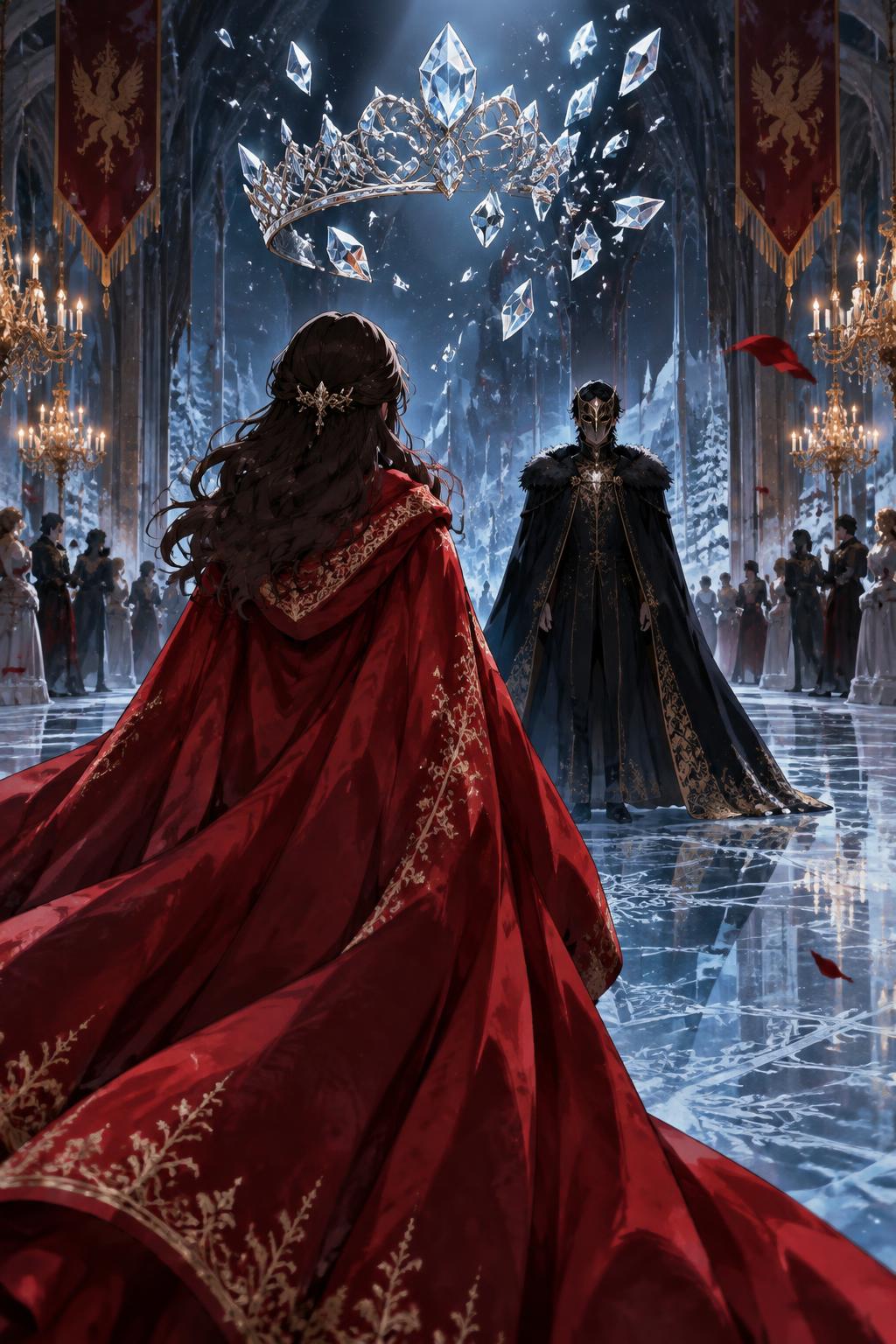
The False Winter Bride
Forced to settle her family's ancient magical debt, Irene infiltrates the boreal court disguised as the betrothed of the ruthless Prince Fadrique. Surrounded by courtiers who weigh loyalty in poisoned wine and crystal daggers, she discovers the prince's icy cruelty is merely a shield hiding a silent ancestral curse. When their calculated farce sparks into a dangerous devotion, choosing to save her clan will mean handing him over to the imperial headsman.