Meningitis and its Shadow · III
~15 min · 3,090 words
There is, however, one absolutely certain thing, and it is this: María Elvira may not remember what she felt in her days of fever, I admit this. But she is perfectly aware of what happened, through subsequent tales. Therefore, it is impossible for me to be devoid of the slightest interest to her. Of charms—God forgive me!—all she wants. But of interest, the man with whom one has dreamed twenty nights in a row, not that. Therefore, her absolute indifference toward me is not rational. What advantages, what remote probability of happiness can ascertaining this bring me? None, that I can see. María Elvira thus guards against my possible pretensions because of that; that is all.
In which she is not right. That I am desperately in love with her, very well. But that I am going to demand the payment of a love promissory note signed upon a meningitis folder, good grief! not that.
Nine in the morning.—It is not a remarkably decent hour to go to bed, but so it is. From the dance at Rodríguez Peña’s, to Palermo. Then to the bar. All perfectly alone. And now to bed.
But not without getting ready to finish my pack of cigarettes, before sleep comes. And here is the reason: I danced last night with María Elvira. And after dancing, we talked like this:
“These little dots in the pupil,” she said to me, facing each other across the little table, “haven’t gone away yet. I don’t know what it can be... Before my illness I didn’t have them.”
Precisely our table neighbor had just pointed out that detail to her. With which her eyes became only more luminous.
As soon as I began to answer her, I realized the pitfall; but it was already late.
“Yes,” I told her, observing her eyes, “I remember that you didn’t have them before...”
And I looked elsewhere. But María Elvira burst out laughing:
“It’s true; you must know it better than anyone.”
Ah! What a sensation of an immense slab finally lifted from my chest! It was possible to talk about that, at last!
“I think so,” I replied. “Better than anyone, I don’t know... But yes; at the moment to which you refer, better than anyone, for sure.”
I stopped again; my voice was beginning to drop too low in pitch.
Ah, yes!—María Elvira smiled. She looked away, serious now, raising her eyes to the couples passing by our side.
A moment passed, for her of perfect forgetfulness of what we were talking about, I suppose, and of gloomy anguish for me. But without lowering her eyes, as if she were always interested in the faces crossing in a film sequence, she added sideways:
“When it was my love, seemingly.”
“Perfectly well said,” I told her, “your love seemingly.”
She looked at me then, returning my smile.
“No...”
And she fell silent.
“No... what? Finish.”
“What for? It’s nonsense.”
“It doesn’t matter; finish.”
She burst out laughing:
“What for? Anyway... you wouldn’t suppose it wasn’t seemingly?”
“That’s a gratuitous insult,” I replied. “I was the first to verify the exactness of the thing, when I was your love... seemingly.”
“Oh, come on!...” she murmured. “But in my turn the demon of madness dragged me after that mocking oh, come on! into a question I should never have asked.”
“Listen to me, María Elvira,” I leaned in: “you don’t remember anything, do you, nothing of that ridiculous story?”
She looked at me very seriously, with haughtiness, if you will, but at the same time with attention, like when we prepare to hear things that in spite of everything do not displease us.
“What story?” she said.
“The other one, when I lived by your side...” I pointed out to her with sufficient clarity.
“Nothing... absolutely nothing.”
“Let’s see; look at me for an instant...”
“No, not even if I look at you...” she let out in a peal of laughter.
“No, that’s not it... You’ve looked at me too much before for me not to know... I wanted to tell you this: Don’t you remember having told me something... two or three words nothing more... the last night you had a fever?”
María Elvira contracted her brows for a long instant, and raised them then, higher than natural. She looked at me intently, shaking her head:
“No, I don’t remember...”
“Ah!” I fell silent.
A while passed. I saw out of the corner of my eye that she was still looking at me.
“What,” she murmured.
“What... what?” I repeated.
“What did I tell you?”
“I don’t remember anymore either...”
“Yes, you remember... What did I tell you?”
“I don’t know, I assure you...”
“Yes, you know... What did I tell you?”
“Come now!” I leaned over the table again. “If you remember absolutely nothing, since everything was a fever hallucination, what can it matter to you what you may or may not have said to me in your delirium?”
The blow was serious. But María Elvira did not think of answering it, contenting herself with looking at me one more instant and looking away with a short shrug of her shoulders.
“Come,” she told me abruptly. “I want to dance this waltz.”
“It’s only fair,” I stood up. “The waltz dream we danced has nothing amusing about it.”
She didn’t answer me. As we advanced toward the hall, she seemed to look around with her eyes for one of her usual waltz partners.
“What unpleasant waltz dream for you?” she told me suddenly, without stopping scanning the hall with her gaze.
“A waltz of delirium... it has nothing to do with this,” I shrugged my shoulders in turn.
I thought we wouldn’t speak anymore that night. But although María Elvira didn’t say a word, neither did she seem to find the ideal partner she was looking for. So stopping, she said to me with a forced smile—the inescapable forced smile that hovered over that whole story:
“If you want, then, dance this waltz with your love...”
“... seemingly. I won’t add another word,” I replied, passing my hand around her waist.
Another month has passed. To think that the mother, Angélica, and Luis María are now full of poetic mystery for me! The mother is, of course, the person whom María Elvira addresses informally and kisses most intimately. Her sister has seen her undress. Luis María, for his part, allows himself to pass his hand over her chin when he enters and she is sitting with her back to him. Three very happy people, as one can see, and incapable of appreciating the bliss in which they find themselves.
As for me, I spend my life bringing cigarettes to my mouth like someone plucking daisy petals: does she love me? does she not love me?
After the dance at Peña’s, I have been with her many times—at her house, of course, every Wednesday.
She keeps her same circle of friends, sustains everyone with her laughter, and flirts admirably whenever they propose it to her. But she always finds a way not to lose sight of me. This when she is with the others. But when she is with me, then she doesn’t take her eyes off them.
Is this rational? No, it is not. And that is why I have had a good laryngitis for a month now, from dint of smoking out my throat.
Last night, however, I had a moment of truce. It was Wednesday. Ayestarain was talking to me, and a brief glance from María Elvira, cast toward us over the shoulders of the quadruple flirt surrounding her, brought her splendid figure into our conversation. We spoke of her, and fleetingly, of the old story. A moment later she stopped before us.
“What are you talking about?”
“About many things; about you first and foremost,” the doctor replied.
“Ah, I figured as much...—And pulling a small Roman armchair toward her, she sat down cross-legged, bust leaning forward, face supported in her hand.”
“Go on; I’m listening.”
“I was telling Durán,” said Ayestarain, “that cases like the one that happened to you in your illness are rare, but there are some. An English author, I don’t remember which one, cites one. Only that it is happier than yours.”
“Happier? And why?”
“Because in that one there is no fever, and both love each other in dreams. On the other hand, in this case, you were solely the one who loved...”
Did I already say that Ayestarain’s attitude had always seemed somewhat tortuous to me regarding myself? If I didn’t say it, I had at that moment a lightning-fast desire to make him feel it, not only with a look. Something, nevertheless, of that yearning he must have perceived in my eyes, because he stood up laughing:
“I’ll leave you two to make peace.”
“Damned pest!” I muttered, already calm when he walked away.
“Why? What has he done to you?”
“Tell me, María Elvira,” I exclaimed, “has Ayestarain ever made love to you?”
“Who, Ayestarain?”
“Yes, him.”
She looked at me hesitating at first. Then, fully into the eyes, seriously:
“Yes,” she answered me.
“Ah, I might have expected it!... At least that one has luck...” I muttered, already completely bitter.
“Why?” she asked me.
Without answering her, I gave a violent shrug and looked the other way. She followed my gaze. A moment passed.
“Why?” she insisted, with that heavy, distracted obstinacy of women when they begin to feel perfectly at ease with a man. She was now, and remained during the brief moments that followed, standing, with her knee resting on the little armchair. She was biting a piece of paper—I never knew where it could have come from—and looking at me, raising and lowering her eyebrows imperceptibly.
“Why?” I replied at last. “Because he has at least had the good fortune not to serve as a ridiculous dummy next to a bed, and can speak seriously, without watching me raise and lower my eyebrows as if my words weren’t understood... do you understand now?”
María Elvira looked at me thoughtfully for a few moments, and then shook her head, with the paper still on her lips.
“Is it true or not?” I insisted, but my heart was already racing wildly.
She shook her head again:
“No, it’s not true...”
“María Elvira!” Angélica called from afar.
Everyone knows that a sibling’s voice is usually most inopportune. But never has a fraternal voice fallen into a deluge of ice and cold pitch so completely out of place as that time.
María Elvira dropped the paper and lowered her knee.
“I’m leaving,” she told me, laughing with the laugh I already knew whenever she faced a flirtation.
“Just a moment!” I said to her.
“Not one more!” she answered, already walking away and gesturing ‘no’ with her hand.
What was left for me to do? Nothing, except swallow the damp little paper, sink my mouth into the hollow her knee had left, and smash the armchair against the wall. And immediately smash myself against a mirror, for being an imbecile. The immense rage I felt toward myself made me suffer, above all. Manly intuitions! The psychology of a worldly man! And the first coquette whose knee is marked there makes fun of it all with unparalleled coolness!
I can’t take any more. I love her like a madman, and what is even more bitter, I don’t know if she really loves me or not. Besides, I dream, I dream too much, and things like that: We were walking arm in arm through a drawing room, she all in white, and I like a black lump at her side. There were only elderly people in the drawing room, and they were all seated, watching us pass. It was, however, a ballroom. And they said of us: Meningitis and Her Shadow. I woke up, and dreamed again: that ballroom was frequented by the daily dead of an epidemic. María Elvira’s white dress was a shroud, and I was the same shadow as before, but now I had a thermometer for a head. We were still Meningitis and Her Shadow.
What can I do with dreams of this nature? I can’t go on. I’m leaving for Europe, for North America, for anywhere I can forget her.
Why stay? To start the same old story over again, burning alone like a clown, or to miss each other every time we feel close? Ah, no! Let’s put an end to this. I don’t know what good this sentimental absence will do to my plans (yes, sentimental!, whether I like it or not); but staying would be ridiculous and stupid, and there’s no point in amusing the María Elviras any longer.
I could write things here quite different from what I have just noted, but I prefer simply to tell what happened the last day I saw María Elvira.
Out of bravado, or as a challenge to myself, or who knows for what morbid suicidal hope, I went the afternoon before my departure to say goodbye to the Funes family. I had already had my tickets in my pocket for ten days, which shows just how much I distrusted myself.
María Elvira was indisposed—a throat issue or a migraine—but receiving visitors. I stepped into the anteroom for a moment to greet her. I found her leafing through sheet music, listless. Upon seeing me she was slightly surprised, though she had time to cast a quick glance at the mirror. Her face was dejected, her lips pale, and her eyes dark with shadows. But she was always herself, even more beautiful to me because I was losing her.
I simply told her I was leaving, and wished her much happiness.
At first she didn’t understand me.
“You’re leaving? And where to?”
“To North America... I just told you.”
“Ah!” she murmured, clearly marking the contraction of her lips. But immediately she looked at me, uneasy.
“Are you ill?”
“Pst!... not precisely... I’m not well.”
“Ah!” she murmured again. And she looked outside through the windowpanes, opening her eyes wide, like someone losing their train of thought.
Besides, it was raining in the street, and the anteroom was dim.
She turned back to me.
“Why are you leaving?” she asked me.
“Hum!” I smiled. “It would be very long, infinitely long to tell... Anyway, I’m leaving.”
María Elvira fixed her eyes on me once more, and her expression, preoccupied and attentive, turned somber.
Let’s get this over with, I told myself. And I pressed on:
“Well, María Elvira...”
She slowly held out her hand to me, a cold, damp hand from her migraine.
“Before you leave,” she told me, “don’t you want to tell me why you’re leaving?”
Her voice had dropped a tone. My heart beat wildly, but like a flash of lightning, I saw her before me, just like that night, walking away laughing and gesturing ‘no’ with her hand: “no, I’m satisfied already”... Ah, no, me too! I had enough with that!
“I’m leaving,” I told her quite clearly, “because I’ve had it up to here with grief, ridiculousness, and shame for myself! Are you happy now?”
She still had her hand in mine. She withdrew it, turned slowly, removed the sheet music from the stand to place it on the piano, all with pause and poise, and looked at me again with a forced and painful smile:
“And if I... asked you not to leave?”...
“For God’s blessed sake!” I exclaimed. “Don’t you realize you are killing me with these things? I am tired of suffering and reproaching myself for my unhappiness! What do we gain, what do you gain with these things? No, enough already! Do you know”—I added, stepping closer—“what you told me that very last night of your illness? Do you want me to tell you? Do you?”
She remained motionless, all eyes.
“Yes, tell me...”
“Well! You told me, and damn the night I heard it, you told me quite clearly this: and—when—you—have—no—more—de—li—rium, will—you—still—love—me? You were still delirious, I know... But what do you want me to do now? Stay here, by your side, bleeding to death because of your way of being, because I love you like an idiot!... That’s quite clear too, eh? Ah! I assure you the life I lead is no life! No, it’s no life!”
I had rested my forehead against the windowpanes, shattered, feeling that after what I had said, my love, my soul, my life, were collapsing forever and ever.
But it was necessary to finish and I turned around: she was by my side, and in her eyes—like a flash of lightning, of happiness this time—I saw sparkling, dizzying, sobbing, the light of damp bliss that I thought was already dead.
“María Elvira!” I exclaimed, I cried out, I believe. “My dearest love! My adored soul!”
And she, in silent tears of ended torment, vanquished, surrendered, blissful, had finally found upon my chest a comfortable resting place for her head.
And nothing more. Could there be anything simpler than all this? I have suffered, it is quite possible, cried, howled with pain, and I must believe it because I wrote it down. But how devilishly far away all that is! And all the more so because—and here is the funniest part of this story of ours—she is here, by my side, reading what I write with her head resting on the pen. She has protested, of course, against not a few of my observations; but in honor of the literary craft into which we have plunged with such freshness, she resigns herself like a good wife. Besides, she believes with me that the general impression of the narrative, reconstructed in stages, is a fairly accurate reflection of what happened, what we felt, and what we suffered. Which, for the work of an engineer, isn’t half bad.
At this moment María Elvira interrupts me to tell me that the last line written is not true: My narrative is not only not entirely bad, but it is good, very good. And as an irrefutable argument, she throws her arms around my neck and looks at me, I don’t know if from much more than two inches away.
“Is it true?” she murmurs—or coos, rather.
“Can one use coos?” I ask her.
“Yes, and this, and this!” And she gives me a kiss.
What more can I add?
End of Episode 27 · of 27
Meningitis and its Shadow · III
Did this episode captivate you?
Invite other readers or create a typographic quote card with your favorite lines.
Read next
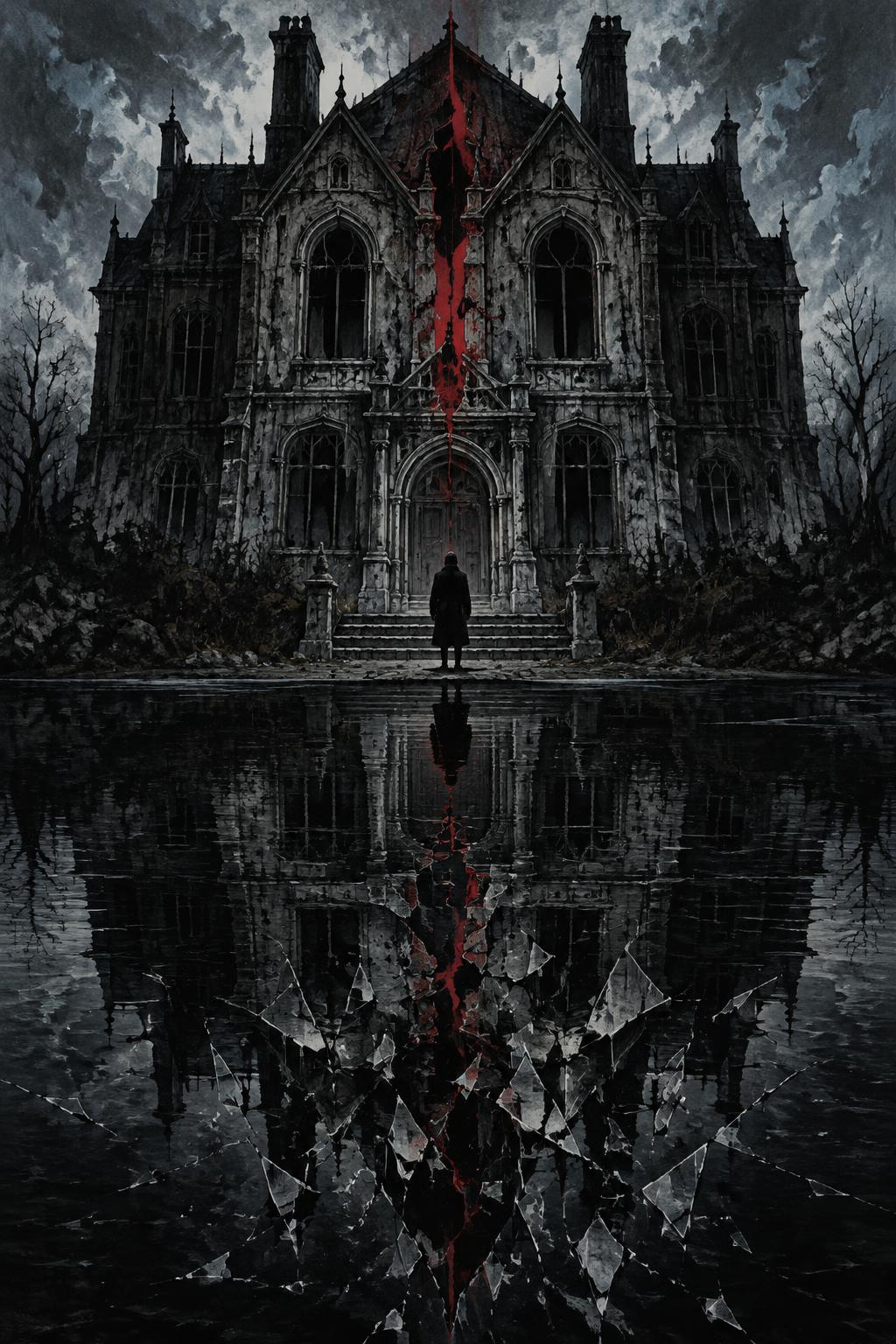
The Fall of the House of Usher
Summoned by a desperate letter from his childhood friend Roderick Usher, an unnamed narrator arrives at a desolate, crumbling estate cloaked in suffocating melancholy. Inside, he discovers Roderick trapped in a severe nervous affliction, while his twin sister, Madeline, languishes under a mysterious, wasting cataleptic illness. As oppressive shadows lengthen across the ancient halls and strange nocturnal melodies echo, a pervasive sense of doom infects the mansion. Surrounded by bleak tarn waters and hairline fissures in the stone, the visitor is drawn into a psychological nightmare where the boundary between decaying architecture and fractured sanity dissolves.