The Last Curve of the Track
~6 min · 1,235 words
The roar of the train faded away among the damp gravel embankments, leaving only the electrical hum of the transformer and two pairs of footsteps on the cobblestones.
The metal of the handrail was soaked in stale frost, sticky with soot accumulated over months of coal dust and fine rain. Martina let go of the rusted pipe with a sharp slap of her palm, not even bothering to wipe the grayish grime against her skirt, and went down the iron steps three at a time. Up on the walkway, Ernesto's boots hit a loose plank. He didn't follow her right away. Ernesto had that way of hesitating that at home always preceded a slammed door: staying still, breathing deeply through his nose as if air cost him money, waiting for the others to feel ashamed before he had to raise his voice.
Air.
She is fourteen years old and the pewter frying pan is smoking on the large stove before the potatoes even touch the bottom. It smells like garlic burning a second before it goes over, that exact second when you can still save the sofrito if you yank it away against the cold marble of the countertop. Ernesto yells at her from the dining room to be careful with the fire, that oil is terribly expensive, that she does everything clumsily, and she pulls the frying pan back with both hands while the handle bites the skin between her thumb and index finger. She doesn't say anything. She watches the golden grease tremble in concentric circles on the sheet metal.
Down below, the fog wasn't rising; it was falling. It caked against the ballast and the ties soaked in warm creosote, that dense stench of treated wood and old diesel that seemed never to evaporate from the tracks. Bruno Llorens had stopped at the very edge where the platform ended and the loose stone riprap began. He wasn't running. He had his brown coat twisted over his right shoulder and the pen still in his hand, the silver nib exposed to the morning dew.
"You're going to run out of ink," Martina said before reaching him. Her voice came out raspy, broken by the run.
Bruno didn't turn around dramatically. He put the fountain pen in the upper pocket of his coat, slowly, snapping the cap on with a tiny click that the canopy transformer almost drowned out.
"It dries right away with this humidity," he replied, turning halfway. "Besides, it's not good Chinese ink. It's school Pelikan. Cheap dye."
"It stains just the same."
"Yeah. It stains just the same."
They looked at each other. A second. Two. The cobblestones were paved with crushed cigarette butts, old cardboard tickets punched by the conductor, and banana leaves shredded by the wheels of the cargo carts. There was no background music, no looks of fatal destiny, nor any of that nonsense people talk about when they think they remember the exact moment their life changed lanes. Just the cold sneaking through the seams of the coat and Ernesto, motionless like a telegraph pole at the top of the iron staircase, watching them with his hands buried in his jacket.
"Your brother's coming down," Bruno said, pointing at the walkway with his chin. He was wearing a gray scarf frayed at the ends, tied lazily.
"Let him come down. If he comes down, he'll have to explain what he was doing with my draft in his pocket."
"He's not going to explain anything. People like him only call for accounts, they don't give them."
Bruno searched for a cigarette in the lining of his coat, found a crumpled pack of dark tobacco, and checked that it was empty before putting it back in his pocket with a short grimace. A useless gesture. A smoker's tic who doesn't know what to do with his fingers when his hands are in the way.
"Do you have matches, at least?" she asked.
"I haven't smoked since Tuesday. I keep the pack out of habit."
"What a silly habit."
"The perspective exam was today at eight," she said.
"I know."
"The freight train never stops."
"I know, Martina."
She corrected herself abruptly inside. She wanted to reproach him for the farce, the triangular messages hidden in the rotting slot of the bench, the stupidity of playing shipwrecked castaways in a station where only four dingy commuter trains stopped a day. She wanted to get angry. No, she didn't want to get angry. She was sick of getting angry; anger in her house was like the dampness in the corners of the pantry, something you learned to live with by putting dry sawdust in the corners.
"I thought you were a machinist," she blurted out with a dry, humorless laugh.
"Machinist, my foot. I work in the south dock feed warehouse. I load sacks of soybeans and barley until four in the afternoon and then I come here to do nothing. To watch the coal go by and wait for seven so I don't have to go back to the boarding house."
"And the notes?"
"The notes were true. I wrote them because this flag stop stinks like a cemetery and you were the only one who didn't lower her head when the engine whistled."
There was no poetry in Bruno's hands. He had his knuckles chapped from grain dust and a bloody hangnail on his index finger from tearing so much burlap.
And she believed him, without further reasons.
The canopy transformer let out a dry crackle, a bluish flicker that illuminated for a fraction of a second the rust on the beams and the dirty water pooled in the gutters. Up above, Ernesto's dark silhouette took a step toward the first flight of stairs, but stopped with one hand resting on the railing, unable to decide whether to cross the gravel border or pretend all that was beneath his dignity as an older brother.
"Ernesto," Martina called out without shouting, barely lifting her head toward the bridge. "If you don't come down now, the eight-ten train is going to catch you up top with the soot."
Her brother's dark bulk didn't answer, but he spat toward the tracks. The dull thud against the ballast sounded crisp in the gap between the two platforms.
Martina sat down on the splintered wood of the bench, wiping her skirt with a resigned gesture. She reached out her hand stained with school ink toward Bruno and, before he could pull the crumpled bill from his pocket, she snatched the notebook from him.
"The last page is missing," she said, running her thumb over the torn edge.
Bruno looked toward the curve where the tracks lost themselves in the mist of the north tunnel.
"I didn't write that one."
Martina looked up at the walkway. Ernesto had finally come down the first flight of steps and stopped halfway, holding something white: a sheet with torn edges, written in the crooked hand of someone who only ever signs delivery notes.
He didn't bring it down. He folded it in four, wedged it between the bars of the railing where she would see it on her way up, and walked home without looking back.
Martina took a while to go and get it. Two lines, in the green ink they only sold at the big station: Sign the enrollment. I'll keep paying for the gas.
End of Episode 4 · of 4
The Last Curve of the Track
Did this episode captivate you?
Invite other readers or create a typographic quote card with your favorite lines.
Read next
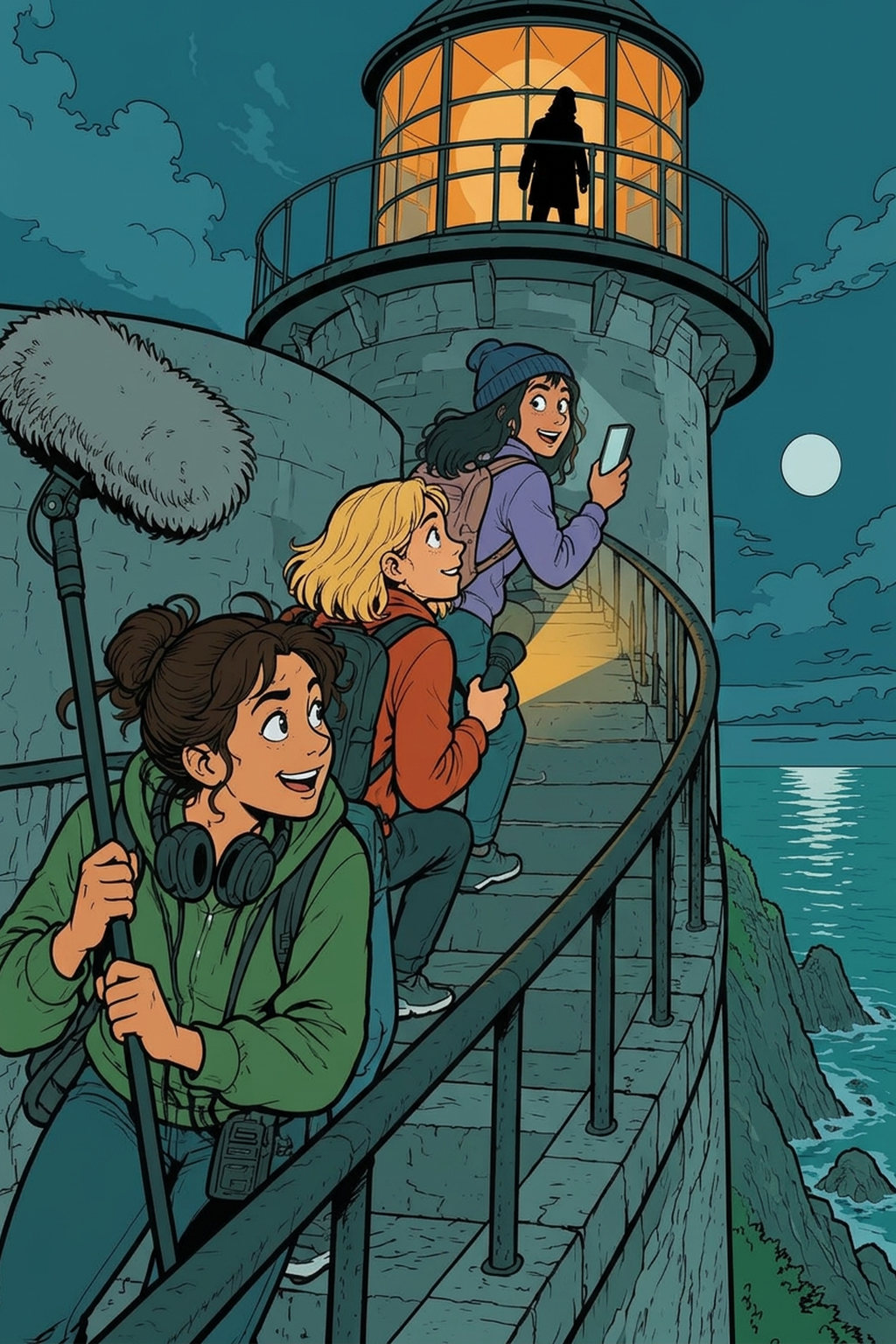
The Mystery of the Old Lighthouse
In the peaceful coastal town of Bahía Serena, three inseparable best friends decide to cap off their senior year by recording a podcast about the local legend of the abandoned lighthouse. But what starts as a prank filled with laughter and tangled cables takes a chilling turn when their audio equipment captures impossible sounds echoing from the locked tower. To uncover the truth before graduation, they must venture into the dark, entirely unaware of the family secret waiting at the top.