The Production Notebook
~11 min · 2,229 words
The world outside Sarah’s window was a blur of urban twilight, blurred by rain that had begun to fall, a soft, persistent drumming against the glass. But her world was far more precise, illuminated by the cold, unwavering glow of three monitors. Lines of code, obscure forum posts, archived web pages, and satellite maps scrolled endlessly, a digital fabric spun from the threads of an obsession that was no longer just a hobby, but a desperate, consuming quest. Her apartment, once a sanctuary, had become a war room; her desk, a command center. Empty cups, crumpled snack wrappers, and a tangle of charging cords formed the remnants of a siege.
She had been at it for what felt like days, with the concept of sleep as a distant, hazy memory. The initial shock of the purchases had transformed into a bitter certainty and, now, into a nearly primitive urgency to understand. Valerie Marsh. The name buzzed in her mind, a low-frequency vibration that resonated with every click of her mouse, every keystroke. Valerie wasn’t just buying props; she was going somewhere. The first breakthrough didn’t come from a direct clue, but from a tangential thread, a loose end Sarah had nearly dismissed. Among the myriad online sellers, an obscure vintage costume shop had left a particularly detailed, though poorly formatted, review comment on a long-defunct forum. It wasn't about the sale itself, but a complaint about a "difficult client" who had insisted on shipping a delicate item—a replica of Iris’s ceremonial cape from Nightshade—to a PO box in a town called Oakhaven, deep in rural Pennsylvania. The seller had complained about the cost, the remote location, and the "vague instructions."
Oakhaven. Sarah’s fingers flew, extracting mapping data. A speck on the map, nestled in the Appalachians, a forgotten hamlet that the highway had bypassed decades ago. It was the kind of place where Nightshade would have been set. Isolated. Overgrown. The kind of place where old secrets lingered in the fog.
She cross-referenced Oakhaven data with every piece of information she had gathered on Valerie Marsh, however tenue it might be. It was a digital archaeological dig, sifting through layers of forgotten internet. Old fan interviews where Valerie vaguely mentioned spending summers "in the north" with a great-aunt. A blurry photo from a 1997 fan convention, a background detail showing a small hand-sewn sampler that read "Oakhaven Quilts." Dismissed as irrelevant at the time, it now pulsed with meaning. A PO box was a dead end for a physical address, but it was a key. It indicated a transient presence, someone who didn’t want to be found, but needed to receive something. Sarah checked Oakhaven's public records. Property deeds, tax arrears, local news archives. The town was dying, with abandoned houses and land returning to the wild. One property in particular caught her attention: a dilapidated farmhouse on the outskirts, listed for sale for years, and then abruptly pulled off the market three months ago, "for private reasons." No sale was recorded, just a withdrawal. Strange.
She zoomed in on the farmhouse using satellite imagery. Overgrown, yes, but a faint track led up to it, recently disturbed. A large, dark vehicle—perhaps a van or an SUV—was partially hidden by the trees. Her heart hammered. The farmhouse, with its leaning porch and the skeletal oak in the yard, was strangely similar to the abandoned mill set in Nightshade, where Iris first encounters the spectral presence. The cape, the farmhouse... everything fit with terrifying precision.
"The abandoned mill," she murmured, feeling the words heavy on her tongue. It was the beginning of the story. Was Valerie working through the series chronologically?
The second address was even more unsettling. A delivery of specialized camera equipment—of the type used for high-resolution, low-light filming—had been sent to a remote cabin deep in the Pacific Northwest, inside the Olympic National Forest. It wasn’t a PO box; it was a specific physical address, though so remote that it barely appeared on most mapping services. She found it by tracing internal couriers' database logs, a vulnerability she had exploited by posing as a disgruntled employee with a "lost package."
The cabin, seen through grainy satellite imagery, was nestled at the edge of a vast, ancient forest, a dark and menacing expanse of Douglas firs and hemlocks. No road led directly to it, only a winding, barely visible logging track. This immediately reminded her of the shadowed forest episode in Nightshade, where Iris ventures into the thicket to find a mythical healing spring, only to confront a monstrous entity. The camera equipment, the isolated forest... the parallels were too stark to ignore.
Sarah’s fingers trembled as she opened archived fan discussions about that shoot in the thicket. One fan theory in particular, always dismissed as extravagant, posited that the series' exteriors were inspired by old Pacific Northwest logging legends, specifically tales of lost hikers on the Olympic Peninsula. A sudden chill ran down the back of her neck. Coincidence? Or was Valerie, or whoever was directing her, recreating in detail not just the scenes, but the very mythology surrounding the series?
The third location was found through a digital crumb so faint it was nearly invisible. A small independent online auction house had listed a collection of ancient religious artifacts: a tarnished silver chalice, a leather-bound Latin missal, a set of iron keys. The listing had been active for only a few hours before the items were purchased. Sarah had only found it because she had set up complex self-learning scripts to scour the entire web for obscure keywords related to Nightshade props. The shipping address was a defunct church in rural Montana, listed as "St. Jude's (abandoned)."
St. Jude's. Sarah remembered the bell tower from the crypt episode of Nightshade, where Iris seeks refuge in an ancient, crumbling church and discovers a hidden altar. The chalice, the missal, the keys: all were specific props from that scene. The Montana church, viewed through Google Street View, was a skeletal ruin, its spire a broken finger pointing at the sky, its windows like empty eyes. The scale of its desolation was breathtaking and terrifying.
These weren't just random purchases. They were specific items, carefully selected, delivered to locations that eerily mirrored the fictional settings of the show. It was a macabre scavenger hunt, a grand and disturbing performance playing out across the continental United States.
Her search extended beyond shipping addresses. She began digging into travel logs. This was trickier. Valerie Marsh, the recluse, wouldn't book flights under her own name, not in plain sight. But Sarah’s skills extended into the gray areas of data. She began searching for anomalies. Large, cash-only bus ticket purchases from small private companies that didn’t usually handle large volumes. She cross-referenced this data with anonymous forum posts or fragments of local news about "unusual visitors" in remote towns.
One such case: a local community forum in a tiny Nevada desert town with a population of 112 had a post from a resident complaining about an "elegant black SUV" that had been parked outside their general store for several days, a woman "in dark sunglasses" seen only at night, buying supplies in bulk. The post's date suspiciously coincided with the purchase of an antique gold-prospector’s lantern and a set of old mining tools, delivered to a PO box in the neighboring town, a ghost town named Dust Devil Gulch.
Dust Devil Gulch. The cursed mine episode featured Iris trapped underground, pursued by a vengeful spirit. The chapter was famous for its claustrophobic tension and the grim, resonant sound design of the mine shafts. The lantern, the mining tools, the desolate desert town... it was another terrifyingly perfect coincidence.
Sarah worked with feverish intensity, fueled by lukewarm coffee and a growing dread. Her screen became a map of the United States, dotted with glowing markers. Oakhaven, PA. Olympic National Forest, WA. St. Jude's, MT. Dust Devil Gulch, NV. Each marker represented a direct echo of Harrow Creek, a physical manifestation of the dark, gothic heart of the series.
Social media breadcrumbs were the hardest to find, the most ephemeral. Valerie Marsh had no public presence. But others did. Sarah combed through geotagged posts by amateur photographers, hikers, and local journalists. She wasn't looking for Valerie, but for the invisible. A landscape photo of a particularly desolate stretch of Montana highway and, in the distance, barely visible, a dark vehicle parked in the ruins of St. Jude. The photo's metadata indicated it was taken just days after the chalice and missal were delivered.
Another case: a fleeting, blurry video clip on a local Washington news station reporting on an unusual surge in tourism in the Olympic National Forest, showing a quick sweep of the thicket. For a fraction of a second, a figure could be seen, small and distant, moving among the trees, a dark cape billowing behind her. Sarah froze the image and zoomed in. The cape, though indistinct, had the same sweep and fall as the replica Iris cape. The video's timestamp coincided with the delivery of the camera equipment.
It was like watching a ghost. Valerie Marsh, a woman who had vanished from the public eye for decades, was now flitting across the country, a specter recreating her most famous role. But why?
Sarah’s initial conviction that Valerie was a victim solidified with every new discovery. No sane, free person would voluntarily undertake such a journey, such a patient and perilous recreation. The isolation of the places, the dark nature of the scenes being recreated; everything pointed to coercion, to a mind under pressure or, perhaps, a fractured mind weighed down by its own past. She imagined Valerie, alone in those desolate places, hooded, acting out scenes that were not only fictional, but steeped in trauma and horror.
The emotional toll was immense. Sarah’s eyes burned and her head throbbed, but she couldn't stop. The thought of Valerie, her idol, the enigmatic actress with whom she felt such a deep connection, out there, lost, manipulated, perhaps even in danger, drove her. She felt an almost spiritual obligation, a unique burden. Who else would see this? Who else would connect these disparate, dark dots? No one. Only she, Sarah Jenkins, conservator of the Nightshade Archive, possessed the knowledge, the tools, and the absolute, unwavering dedication to piece together this terrifying puzzle.
She found a pattern. Not just the order of the scenes, but the type of location. Each one was more remote, more desolate, and more inherently dangerous than the last. The mill farmhouse was in ruins but accessible. The shadowed forest was vast and wild. The Montana church was a crumbling ruin in a ghost town. The Nevada shaft was literally an abandoned mine in a desert. The trajectory was clear: deeper into isolation, deeper into danger.
The question was where all of this was leading. If whoever was orchestrating this was following the emotional geography of Nightshade, what was the logical next step? The never-aired finale, the legendary Requiem, remained a shadowy territory of which only fragments and rumors survived. There was no obvious destination on the screen: only an implacable scattering that defied any linear travel logic.
Sarah opened a blank file and began plotting vectors between the points: Pennsylvania, Washington, Montana, Nevada, Vermont, New York. The markers covered thousands of miles. Whether Valerie was traveling between those points or multiple people were moving the pieces simultaneously, the logistics were maddening. It felt less like a real itinerary and more like a dismembered production notebook, intentionally scattered across the map to recreate each chapter without ever revealing the base of operations.
She spent hours cross-referencing transport logs, toll booths, traffic cameras, and fuel purchases on the intermediate routes, searching for the center of gravity of that network. Her eyes burned from the constant monitor glare. The searches yielded hundreds of false positives: short-term rentals that led to nowhere, vans vanishing onto back roads, PO boxes rented by anonymous intermediaries.
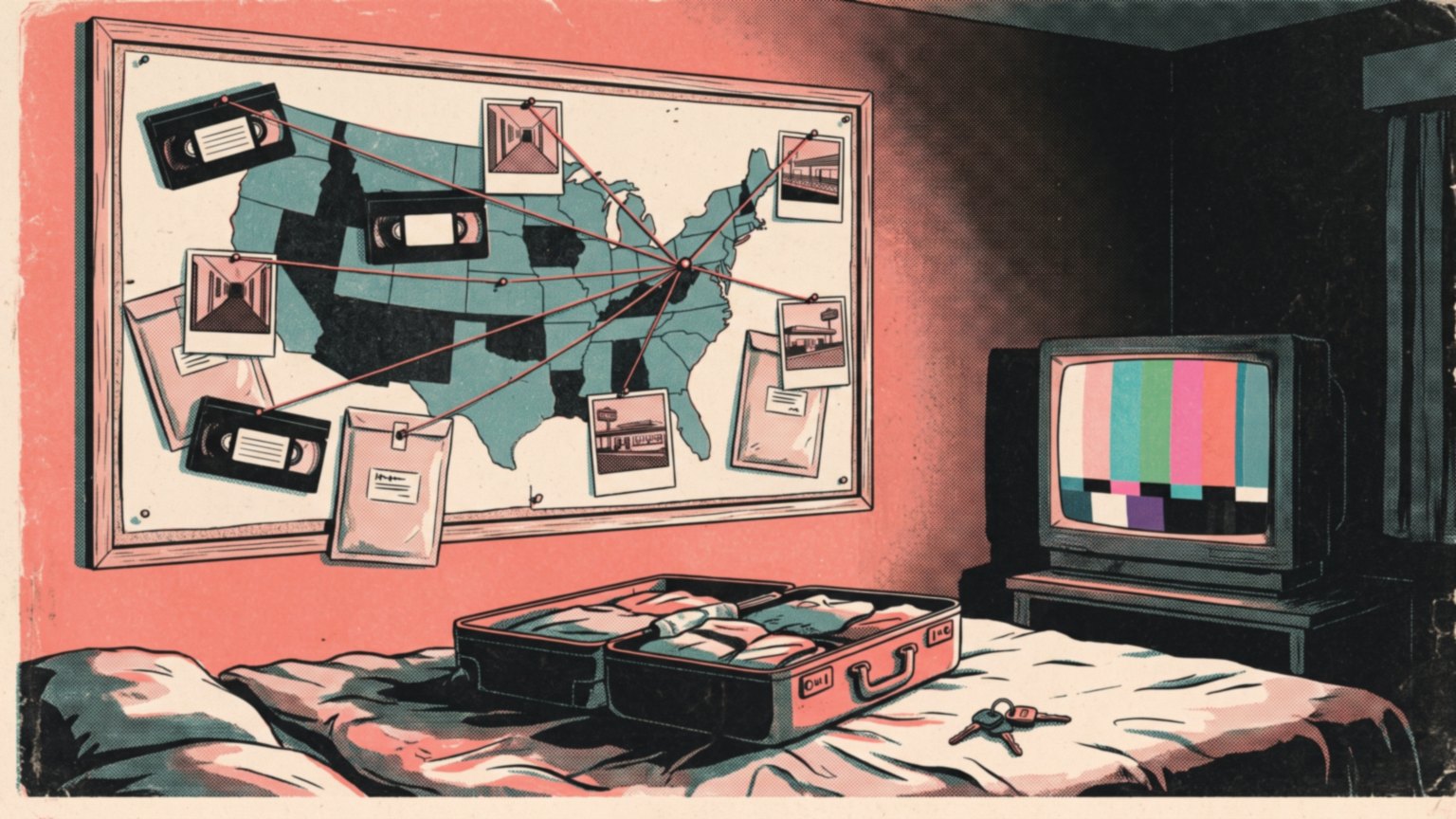
The trail, far from converging, fanned out impenetrably. There was no fixed coordinate, no headquarters, no city to hunker down in. Montana offered the chalice and that blurry diner photo; Washington held the echo of the cape among the trees; Pennsylvania harbored the silent farmhouse. But none of those places were a command post. They were ephemeral sets, blitz-shoots staged for a solitary camera and abandoned almost immediately.
She leaned back in her chair, rubbing her eyelids hard. The feeling of suffocation in the apartment was palpable, but the map on the screen remained mute regarding the climax. She couldn't jump in a car and drive toward the four cardinal points at once. Not yet.
Sarah stared at the constellation of digital lights over the US map. The figure in the dark cape captured in the forest video kept looping in a corner of the screen, a ghostly frame fading among the firs. Whoever was pulling the strings knew exactly how to keep attention scattered, sowing breadcrumbs that never quite coalesced into a single destination.
Valerie was out there, trapped in that maelstrom of celluloid and shadows, but the labyrinth had not yet shown its center. Sarah rested her fingers on the keyboard, holding her breath, determined not to look away until a single crack in the data revealed the true vanishing point.
End of Episode 5 · of 36
The Production Notebook
Did this episode captivate you?
Invite other readers or create a typographic quote card with your favorite lines.