Geometry of a Consummated Shipwreck
~10 min · 2,008 words
The bronze reactor stopped pushing against the station's belly and the recycled air suddenly thickened, heavy with a sour stench of overheating insulation and stale sweat. In the guardroom, the only sound was the irregular pulse of the secondary console's fan and the rhythmic click of the brass pen Commissioner Strand held between his index and middle fingers. Click. Click. Click. Teodor clenched his jaw until the clicking reverberated in his skull bones. Strand did not even blink.
Sparse, crew-cut hair. Starched collar. No rush.
"Is there any chicory left in the pantry, Sofia?" Strand asked without taking his eyes off his dust-jacketed notebook.
"We ran out on Tuesday," Dr. Lem replied.
"I could have sworn I left half a tin next to the selenium filters."
"It's gone, Halvard."
Strand stopped his thumb over the pen's plunger, took a deep breath through his nose, and pulled open the bottom drawer of his sheet-metal desk. He took out a transparent plastic pillbox, divided into seven compartments with the days of the week almost rubbed off by the grease of his fingertips. With his pinky nail, he lifted the Thursday lid and pulled out two mustard-colored pills. He slid them under his tongue without water, swallowed with a visible bob of his Adam's apple, and snapped the compartment shut again. On the floor, the bulkhead's expansion joint groaned half a millimeter inward.
Pain flared at the root of Teodor's upper left second molar. It was a live, electric ache that traveled down the trigeminal nerve every time the gyroscopes lurched to compensate for the drift. He brought three fingers to his left temple, pressing hard against the damp skin to dull the thumping before it clouded his vision with brown spots. The aftertaste of old copper soaked his saliva, thick as if he'd been sucking on a handful of rusted coins picked up from the bilge floors. The main console—a coffin of black bakelite and mild iron rivets—reflected his own face back at him through the curved glass of the screen: a spectral stain tinted with green phosphor, sunken eyes, and a bottom lip split by a dry crust he couldn't stop chewing.
"The differential on the longitudinal axis keeps widening," Teodor said, pointing to the needle of the torsion galvanometer. "The ferrite needles aren't seating. They're skating on the bearings."
"I logged that twenty minutes ago, Officer Kask," Strand replied without looking at him. "Continue with the power-drop log."
What no one asked was why Halvard hadn't bothered to put on his restraint harness.
Sofia Lem stood beside the optical calibration bench, her shoulders hunched inside a lab coat two sizes too big for her. In her hand she held a grayish paper napkin, one of those rough military mess-hall ones, smoothing it over and over against the stainless-steel edge of the table with the base of her thumb. She flattened it, folded it down the exact middle, opened it back up, and smoothed the edge of her hand across it again as if trying to iron out an invisible wrinkle. Her brown hair was gathered in a messy bun, strands glued to her cheeks by the condensation dripping from the ceiling pipes.
"There's nothing to log for the drops, Halvard," Sofia said softly, without lifting her eyes from her napkin. "The telemetry package that came down on the last magnetic tape already bore the closing seal. The entire block."
"A decoding error in the valves," the commissioner countered, turning a page of his notebook with bureaucratic neatness.
"It wasn't a reading error."
"Thermionic valves accumulate noise with the gradient, Doctor. You know that better than I do."
"It had my sign-off at the bottom of the header," she said. She laid the napkin on the sheet metal, folded in four, and looked up. Her eyes were bloodshot, pupils reduced to specks by the sulfurous glare of the cathode tubes. "And yours. With the verification code you generated at zero-four-hundred."
Silence.
Teodor pulled his hand away from his temple and lowered his gaze to the clutch crank of the data spool. The metal was cold, coated in a viscous film of graphite soot that clung to the lines of his palm. He tried to swallow air, but the room's air seemed to have lost its substance, replaced by that caustic vapor of burnt turbine oil that failed to feed the lungs. In his knees, synovial fluid burned as though someone had injected molten lead into his joint capsules; the tide pulled his bones downward while the station's mass tried to sustain itself in an orbit that no longer existed.
Sofia picked up the napkin again. She folded a corner, creasing it with her nail until the paper nearly tore.
"If the antenna winch doesn't respond," Teodor muttered, listening to the dull groan of C-deck bolts two levels down, "the probe will get jammed in the ejection airlock."
"The probe is not going to eject," Strand said. His tone was flat, identical to a screw inventory. "The documentary quarantine directive prohibits the emission of unfiltered bursts from the declination sector. Your job is to seal the hopper and wait for relief."
"What relief, Halvard?" Teodor's voice sounded harsh, cracked by throat-dryness. "There's nobody within six light-weeks. If we step out of the envelope, incoming transmissions will have been cooked in X-rays before they even touch the dish."
"Follow protocol, Officer Kask."
Strand did not look up. His hand kept filling in the ledger cells with tiny, precise numbers, pressing the brass tip hard enough to tear the gray pulp of the paper. A drop of cold sweat hung paused in the fold of his double chin, but his fingers did not tremble as he drew the closing line.
"I'm going to the aft bay," Teodor said.
"I order you to remain at your station," Strand said, but his pen kept racing across the line without hesitation.
Teodor did not answer. He turned around, dragging his right leg because his hip joint refused to bear the uneven weight of the gradient, and shoved the heavy watertight hatch toward the service corridor. The cast-iron handle tore a hangnail from his thumb, leaving a dark smudge on the peeling paint, but he didn't even stop to rub the wound.
" ◇ "
Service corridor number four smelled of damp rags and the creosote used to seal the expansion joints. Every three meters, an emergency sconce with a carbon-filament bulb cast cones of yellowish, flickering light onto the bare pipes. All the hatches were identical: rectangles of riveted steel with an armored glass peephole at eye level, fogged from the inside by a condensation nobody had wiped away in months. Walking through it was advancing down a tunnel that seemed to repeat itself at every stretch.
And it groaned.
It wasn't a sharp snap or the whine of sheet metal vibrating from overload. It was a telluric, deep lament—the sound of a thousand-mile-thick ice sheet suddenly tearing across a deep bedrock bed. The carbon steel of the main bulkheads complained at a frequency so low Teodor didn't hear it with his ears, but in the cartilage of his sternum and the base of his skull.
The entire station lost three degrees of trim in less than a second.
Teodor fell sideways against the cooling-pipe railing. His elbow slammed into a protruding nut and the impact sent an electric shock all the way to his pinky and ring fingertips, leaving his right hand numb, dangling like a piece of dead meat. He took a deep breath, swallowing soot, and forced himself to stand by leaning on his healthy knee. A shower of dry rust flakes and asbestos dust shook loose from the ceiling, landing on his eyelashes and the collar of his coveralls.
"Kask," Sofia's voice came distorted through the wall horn intercom, broken by static crackles that sounded like gravel thrown against a tin drum. "Halvard took the other five pills. He locked himself in the record archive."
Teodor pressed the intercom lever with his left palm.
"Come to the ejection bay, Sofia. Bring the spare ferrite tapes."
"I can't open the Deck B airlock, Teodor. The frame warped. The door... won't budge. There's a two-centimeter misalignment at the lintel."
"Push it with the unjamming bar."
"It's shearing the partition, Teodor. The ribs are buckling inward toward the center of the corridor."
A long pause. The static hum in the horn grew into a steady hiss, like boiling oil in a distant frying pan. On the other end of the line, Teodor could hear Lem's ragged breathing, fast, shallow—the sound of someone trying to fill lungs that no longer received enough pressure to expand.
"Sofia," he said.
"I found the ten o'clock tape reel," she said, in a voice that had suddenly lost all urgency, flat and empty. "The damage report that came in through the long-range antenna early this morning... it didn't come from the twin station. The header has my operator serial number. And yours."
Teodor clenched his teeth until the pain in his gums made him see green sparks at the edges of his vision. He pulled away from the intercom without hanging up the handset, leaving it swinging at the end of its braided cloth cord like a dead pendulum, and broke into a run down the final stretch of the corridor toward the probe chamber.
Gravity no longer pulled toward the station's keel: it pulled in a spiral, twisting the space between the walls as though someone were wringing out a wet rag. The metal-grate floor arched beneath his boots with a din of rivets violently popping against the plates. One of the bolts grazed his cheek, opening a thin cut from which a trail of dark blood droplets welled up, floating toward the upper-left corner of the bulkhead instead of falling to the floor.
The ejection bay was a narrow cell dominated by the conical nose of the electromechanical escape probe. The cylinder of bakelite and lead shielding rested on a launch ramp tilted toward the outer nozzle, connected to the data terminal by a thick hose of asbestos-wrapped cables. In front of it, the fifty-hertz green phosphor monitor flickered with an agonizing fury, blurring the sweep lines into an uncontrollable horizontal tremor.
Teodor lunged at the control panel. The smell there was unbearable: burnt rubber, copper sulfate, and the thin air of a microscopic breach already whistling somewhere behind the armor plating.
He placed his left hand on the manual ejection lever. The iron was freezing, sweating a greasy condensation that slipped between his fingers, stiffened by the synovial spasm.
On the screen, the mechanical ferrite cursor began punching the log tape at a demonic speed, striking the paper with the sound of a distant machine gun. Teodor stared at the alphanumeric characters printing in the control window before being devoured by the reading needle:
FINAL LOG / SUBJECT: VARGA, M. / VITAL STATUS: FIELD DISSOLUTION / TELEMETRY EMITTED AT ZERO-SIXTY-FOURTY-TWO.
The clock on the bulkhead read zero-six-forty-one.
The paper roll kept devouring the blank tape with a continuous click.
A master beam cracked overhead with the dry sound of a femur snapping under a sledgehammer. The outer bulkhead bulged inward, warping the steel at a blind angle that left no room for air. The monitor shattered in a shower of glass splinters that did not fall; they remained suspended in the room, reflecting the dying phosphor like a swarm of chemical fireflies.
Teodor's mouth filled with warm blood.
The pain in his temples turned into a red-hot nail driving through his eye sockets from side to side, blinding him completely as the gravitational gradient began to crush the deck plating, folding the carbon steel back on itself as if it were moistened cigarette paper.
With his numb fingers clamped over the probe's grip, Teodor pulled the ejection lever with all his body weight at the exact moment the bulkhead gave way, launching the ferrite cartridge into the void before the cabin finished sealing over his chest.
End of Episode 3 · of 3
Geometry of a Consummated Shipwreck
Did this episode captivate you?
Invite other readers or create a typographic quote card with your favorite lines.
Read next
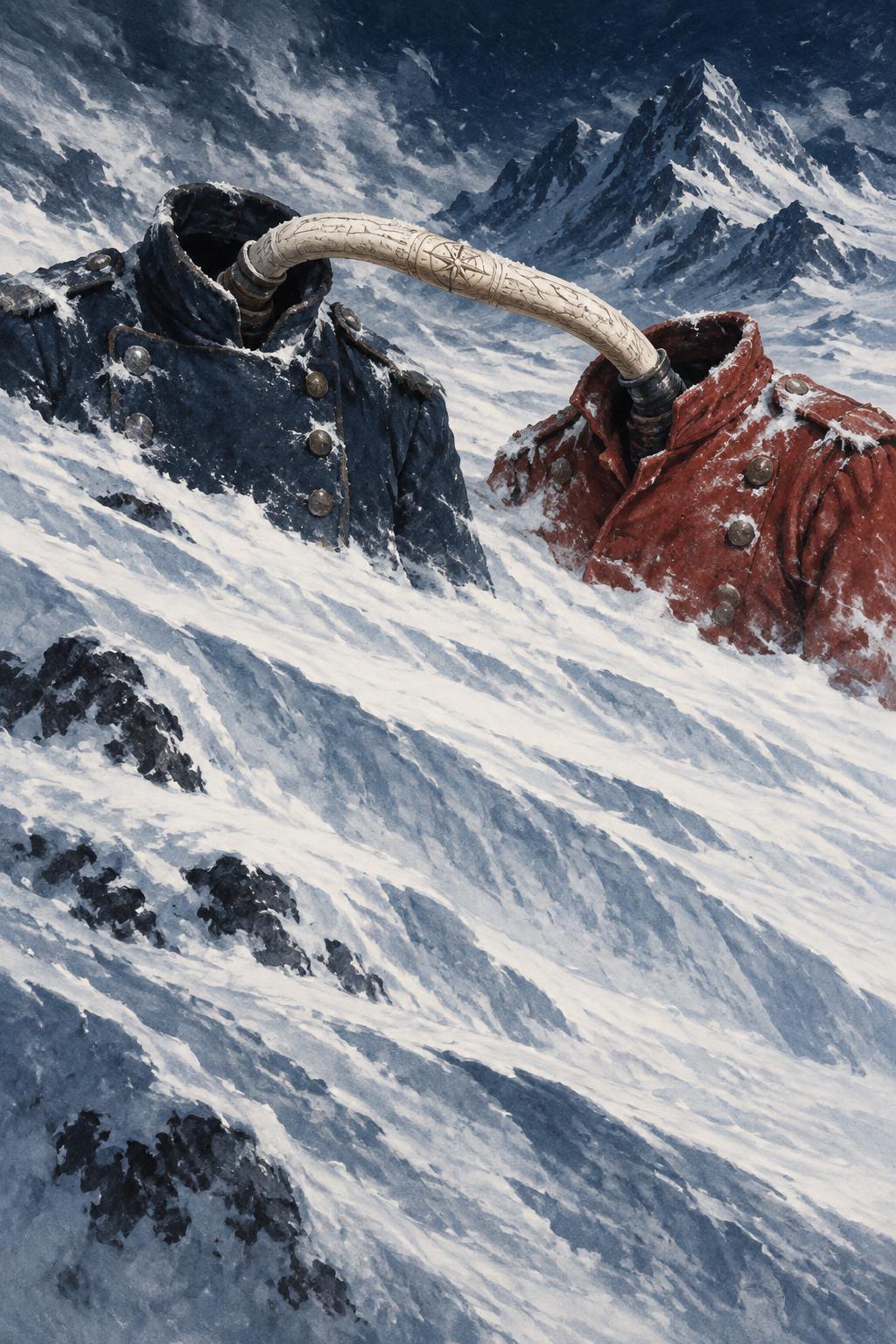
The Ivory Cannula
In a northern Norwegian outpost buried by the blizzard, Corporal Einar wakes with an ivory cannula sewn into his wrist. At the other end of the tube breathes Nicolai Voronin, the Russian gunner who once had Einar's company in his sights, and the doctor who joined them so they could share the warmth of their blood sits dead on his stool. With no firewood, no air and the roof giving way, Einar has to keep his enemy alive if he wants to stay alive himself.